• Skip to main content
  • Skip to primary sidebar
  • Skip to footer

Tip of the Spear Ventures

A Family Office that behaves like Venture Capital | Private Equity | Business Consulting

  • Advisory Services
    • BRANDING & GTM
    • BUSINESS GROWTH
      • PE & VC Portfolio Growth
      • Executive Coaching for PE & VC
    • VENTURE FUNDING
      • Capital Raise & Network Access
    • M&A
  • FO Direct Investments
  • The Point Blog
  • Contact Us
  • FREE eBOOK

sam palazzolo

Sales Strategy Consulting for Startups – 5 Tips!

February 20, 2023 By Tip of the Spear

The Point: Starting a new business can be an exciting and rewarding experience, but it’s also a challenging one. At our sales consulting firm, The Zeroing Agency, we know that one of the biggest challenges that many startups face is developing a successful sales strategy. Without a well-defined sales strategy, it can be difficult to generate the revenue necessary to sustain and grow a business. This is where sales strategy consulting for startups can make a huge difference. By working with a team of experts, startups can develop and implement a sales strategy that will help them achieve their business goals. In this blog, we’ll explore what sales strategy consulting for startups is and how it can help your business…Enjoy!

Transform Your Business.

Download your free 37 page | 128 question Business Transformation Self-Assessment.

DOWNLOAD NOW

Sales Strategy Consulting for Startups

Sales strategy consulting for startups is a service that helps new businesses develop and implement a sales strategy that will help them achieve their business goals. According to a report by Statista, in 2021, there were 4.5 million small businesses in the United States, which highlights the importance of sales strategy consulting for startups.

Sales strategy consulting firms work closely with startup founders and other key stakeholders to understand the business’s unique selling points, target market, and competition. Based on this understanding, they develop a sales strategy that will help the startup generate the revenue necessary to sustain and grow the business. This can include developing a sales process, identifying target markets, creating customer profiles, and providing training and coaching for the startup’s sales team.

According to a survey conducted by HubSpot, 30% of startups identified generating revenue as their biggest challenge. This is where sales strategy consulting can make a significant difference, by providing startups with the tools and strategies they need to generate more revenue and sustain their business.

Sales strategy consulting is not just about generating revenue, but also about helping startups build a strong foundation for future growth. According to a study by the Kauffman Foundation, 20% of new businesses fail in their first year, while 50% fail within five years. Sales strategy consulting can help startups avoid becoming part of these statistics by providing them with a well-defined sales strategy that can help them weather the challenges of the early stages of their business.

How Can Sales Strategy Consulting Help Your Startup? 5 Tips!

  1. Develop a sales strategy that is tailored to your business’s unique needs: Every business is unique, and a one-size-fits-all sales strategy is unlikely to be effective. Sales strategy consulting for startups ensures that the strategy developed is tailored to the specific needs of your business.
  2. Identify target markets and create customer profiles: Sales strategy consulting can help you identify your target markets and create customer profiles. By understanding who your customers are and what they need, you can develop a sales strategy that speaks to their needs and generates more revenue.                                   
  3. Create a sales process that works: A successful sales process is critical to the success of any business. Sales strategy consulting can help you develop a sales process that is effective and efficient, saving you time and resources.
  4. Train your sales team: Sales strategy consulting can provide training and coaching for your sales team. This training can help your sales team understand the sales process, build relationships with customers, and close more deals.
  5. Monitor and evaluate results: Finally, sales strategy consulting can help you monitor and evaluate the results of your sales strategy. By tracking key performance indicators (KPIs) and analyzing the results, you can identify areas for improvement and make adjustments to your sales strategy as necessary.

SUMMARY

Sales strategy consulting for startups is a valuable service that can help new businesses develop and implement a successful sales strategy. If you’re a startup looking to grow your business, consider working with a sales strategy consulting firm, The Zeroing Agency, and enhance your startup’s sales strategy with our expert sales consulting. Let us develop a custom strategy that aligns with your business objectives and sets you up for growth. CONTACT US today!

Sam Palazzolo, Managing Director

Filed Under: Blog Tagged With: sales consulting, sales consulting firm, Sales Strategy, sales strategy for startups, sam palazzolo, the zeroing agency, tip of the spear ventures

Should You Call a MEDDIC to Improve Your Sales Procedure?

January 23, 2023 By Tip of the Spear

The Point: When should you call a MEDDIC to improve your sales procedure? Yes, we meant to spell it “MEDDIC” instead of MEDIC! Why? If you’re old enough to remember the television series M*A*S*H (or a Hulu Plus subscriber), you know the benefit a Mobile Army Surgical Hospital for the front-line position. We would argue that Business Sales/Marketing is similar to wartime, inasmuch you most likely will have casualties. Instead of these casualties being life/death, they are go/no go for the campaigns you run as an organizational Sales/Marketing Leader. So, in this post we explore the MEDDIC sales procedure… Enjoy!

Should You Call a MEDDIC to Improve Your Sales Procedure?

The MEDDIC Sales Procedure

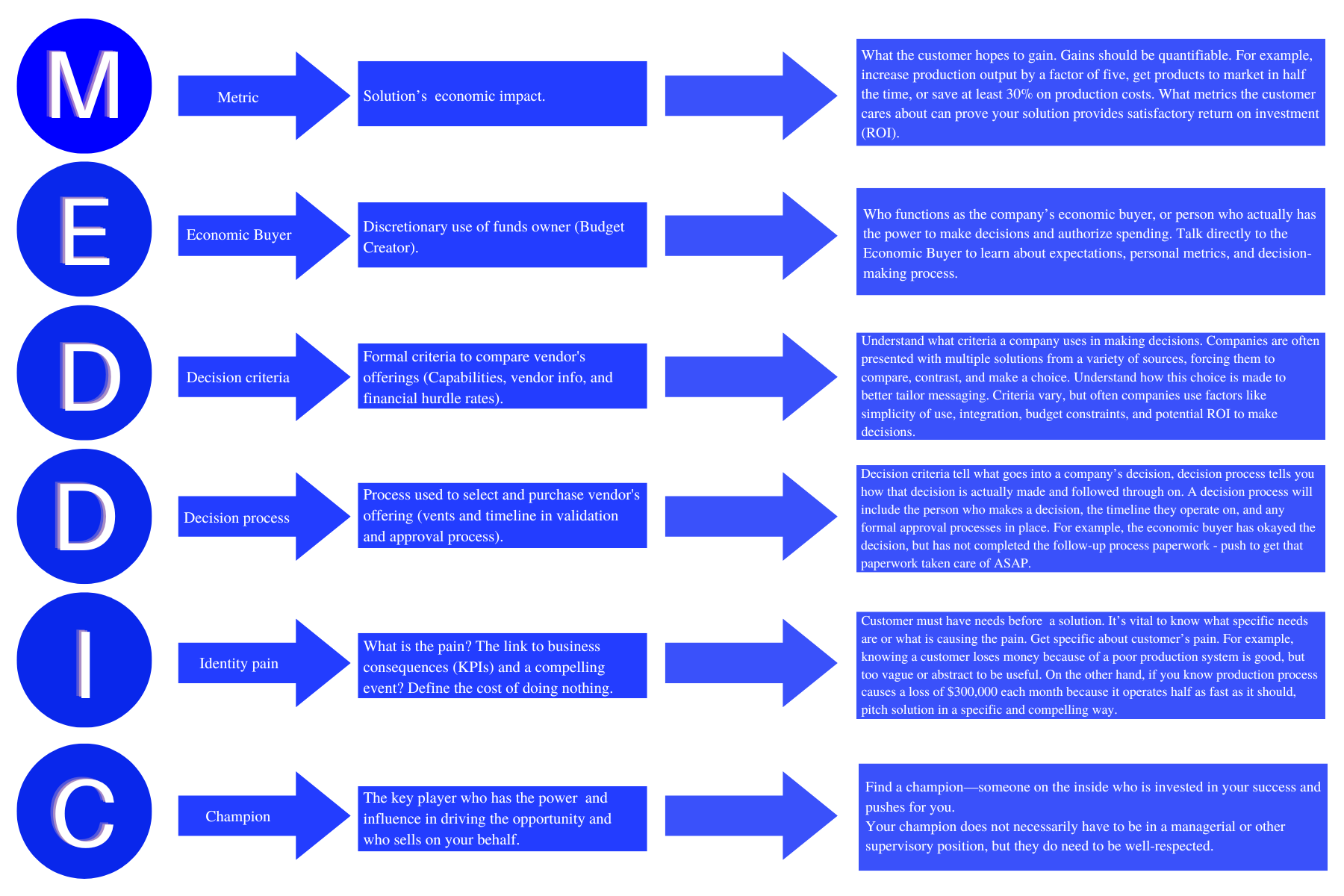
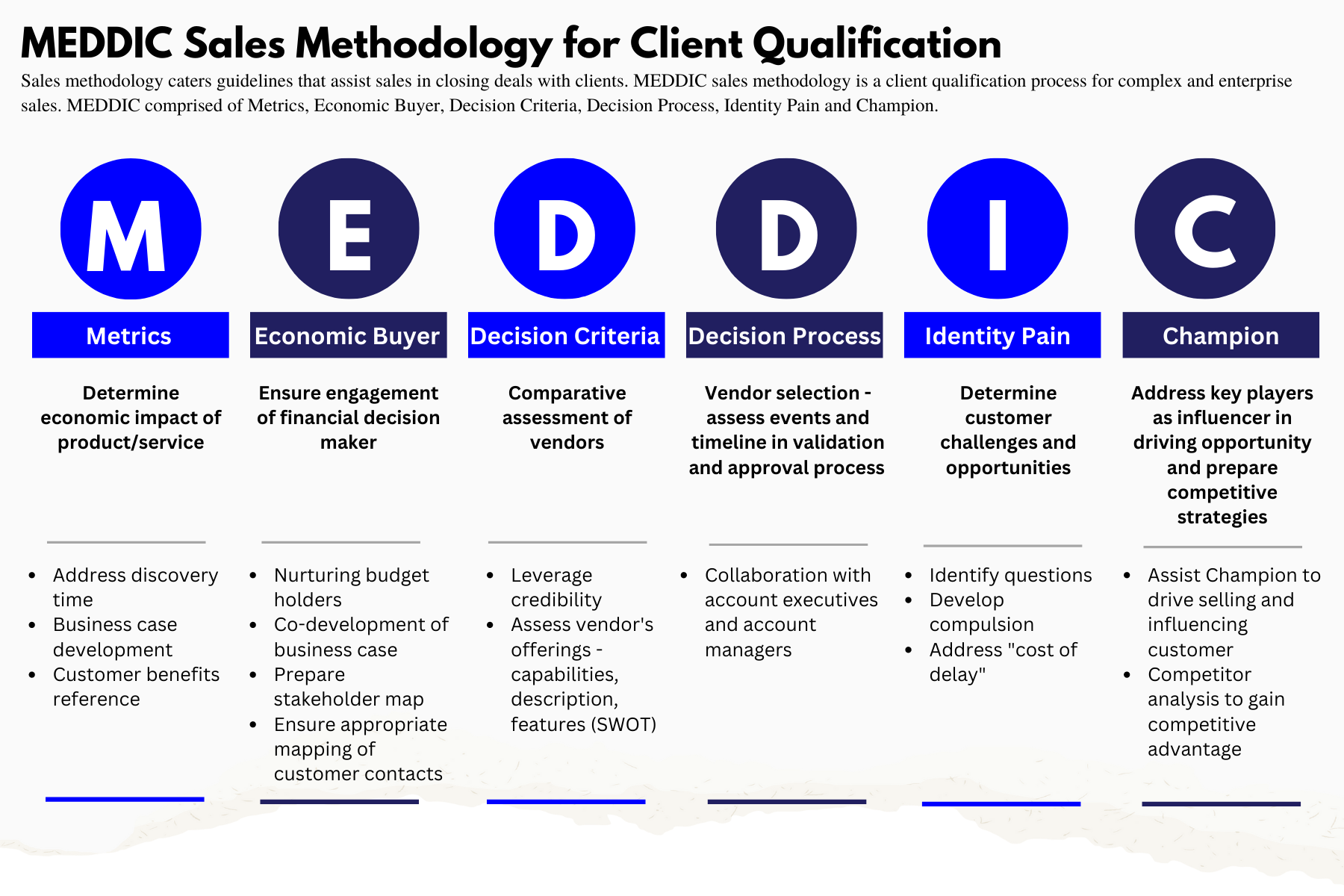
An acronym, MEDDIC stands for Metrics, Economic buyer, Decision criteria, Decision process, Identify pain, and Champion. This sales procedure emphasizes better customer qualification—determining if you should expend effort getting a prospective customer into your sales funnel.

The MEDDIC Sales Procedure

The MEDDIC sales procedure is a B2B sales methodology that was developed in the early 1990s. The process focuses on better customer qualification, in other words, determining whether you should put effort into getting customers into the sales funnel. Supporters for the MEDDIC sales method assert that pitching more qualified customers leads to a greater closing rate, which in turn increases sales performance.

MEDDIC is an abbreviation for Metrics, Economic buyer, Decision criteria, Decision process, Identify pain, and Champion. These are the six steps concurrently utilized to identify customers within the MEDDIC sales process.

Metrics

The first step is to determine what the client hopes to achieve in gaining from your product. The gains must be easily quantifiable. For instance, the business may wish to increase the amount of products that they produce by four times the rate or they may need to bring their products out within a half-hour or to cut down at least 20% of manufacturing expenses.

These metrics allow you to explain the economic advantages from your service. Once you’ve identified this is important to the customer, it is possible to demonstrate that your solution can provide a high Return on Investment (ROI). If you are able to justify your solution from an economic perspective, in theory you’ll be just a few steps away from closing your deal.

Economic Buyer

You must know who’s the company’s buyer of economics that possesses the authority to decide and approve spending. In most cases, you’ll be speaking to someone additional in the organization than just your current contact (For example, the decision could come from a Consensus Committee). Knowing the business buyer’s mindset and their perspective will assist you in closing sales because the buyer’s veto power means they are the only one that needs to be convinced.

Plan on directly contacting the economic buyer to learn about their success metrics, their expectations, and their decision-making process. However, in certain situations speaking directly is not possible, and you must attempt to gather these details about the buyer from the person you have contacted. Utilize these details to ensure the purchase appeal to the buyer even if they aren’t going to necessarily be affected directly by the sale.

Decision Criteria

Also, you must know the business’s criteria when making its choices. Businesses are frequently faced with different options from various sources and are forced to review and choose. If you can understand why they arrive at their decisions then you can tailor your message accordingly.

The criteria for judging differ, but generally businesses consider factors such as ease of use/integration, budget restrictions, and possible ROI in making their decision. If the prospective company doesn’t have clearly defined criteria for making decisions, you could ask them to write it down on paper. This is a way to show that you meet all the criteria they have, and potentially showing them the “Why?” associated for them to not accept an offer.

Decision Process

The decision process will tell you what factors influence the decision-making capabilities of the company and the process that decision making takes as well as which are actually taken and then followed up on. The decision process should include the person who is responsible for making a decision, the deadline they work on, as well as any formal approval procedures in the process.

If you are aware of the process of making decisions, you’re less likely to miss out on the sale because of stagnation. You know precisely what has to be done for the company’s part to conclude the sale, and you are able to work to fulfill those requirements. If, for instance, you are aware that the economic buyer has ok’d the purchase but hasn’t completed the follow-up procedure documents, you may make an effort to have that paperwork completed, thus closing the deal.

Identify Pain

A client must be in need prior to deciding to seek the solution. In other words, no change will occur until the pain associated with staying the same (doing nothing) is greater than the pain associated with changing (switching vendors to you!) It’s essential to determine what that requirement is or what’s making them feel pain (suffering?). The pain may be manifested in various ways, such as high costs as well as slow production and poor revenues. Find out what pain your customer is feeling and figure out what solution you can offer to alleviate the discomfort. What happens in the event that they fail to choose the right solution, or make a mistake? What will be the solution to be able to fix the problem?

Be as precise as you can about the customer’s issues. For instance, knowing that the customer is losing money because of slow production is vital. However it’s not sufficiently specific or abstract to put into use. It is specific though if you know that they’re losing $300,000 per month due to their production process because it isn’t nearly the speed it ought to be. In this scenario, you could propose your solution with a specific and persuasive method for improvement therein.

Champion

Find a person on the inside who’s invested in your progress and who pushes to help you. The person who champions your cause is likely to be the one who is the most affected by the company’s struggles or who will benefit the greatest from the solution. Since they’re interested in your solution, they want you to succeed and will leverage their influence to market the solution internally.

Your champion doesn’t necessarily need to be in an executive or other executive position (but it sure does help), but they should be respected. A person who is known as self-centered and uninterested in advocating for you is never the best choice. However, having a champion who has influence and respect on your side could make all the difference in closing future deals.

Should You Use the MEDDIC Sales Technique?

The MEDDIC sales technique is an easy checklist for your sales operation. It will ensure that your sales are backed by all of the details that you need and the easy acronym makes it simple to recall what that you’re required to know. Since the MEDDIC sales procedure is based on learning rather than making sales through tricks it’s simple to use even for people who aren’t considered to be “salesy.”

Furthermore, the MEDDIC sales strategy provides you with the data you need to be able to precisely assess your prospects. Once you understand more about your prospective clients you will then know if they’re worth your time. This will aid in forecasting your sales since you’ll not be creating leads that won’t be profitable in your pipeline for sales.

Implement the MEDDIC Sales Procedure – Where to Start?

As you can see from the previous steps, the MEDDIC sales procedure provides specific guidelines on how to gain more information about the potential customers you are targeting to convince them of your service or product’s worth. How do you get your sales reps to use this method?

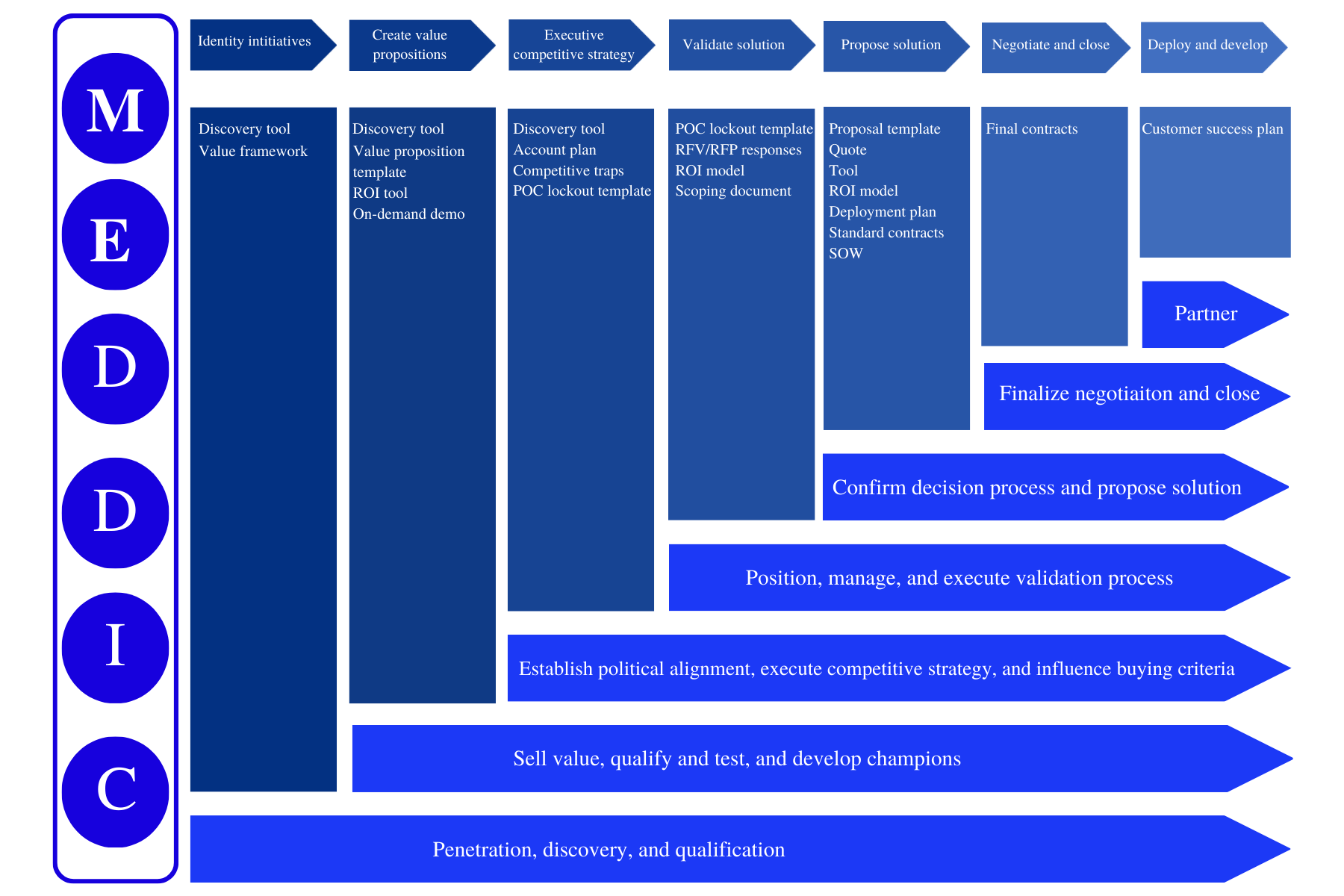
Begin by visualizing the process. It’s not only the basics of MEDDIC, but how the steps are tailored for your company. This could involve creating an outline of the collateral you should use at each step or conversation trees to aid reps in identifying winners and points of contention (These are in your Sales Playbook, right?)

Next, make sure that your sales reps keep accurate records of meetings with prospective customers and other interactions using their MEDDIC procedures to make sure they are following the entire MEDDIC process. For instance, you could add fields to your CRM that correspond to each of the steps or develop a template such as the one below.

SUMMARY

If you are able to qualify and understand your clients Your sales team will be able to focus their time on opportunities that are most likely to work and discover the value that will get this deal across the line to “Closed Won” status! If you’d like more information on how we can help you implement MEDDIC or other Sales/Marketing best practices, CONTACT US today.

Sam Palazzolo, Managing Director

Filed Under: Blog Tagged With: champion, decision criteria, decision process, economic buyer, identify pain, meddic, meddic sales procedure, meddic sales technique, metrics, sam palazzolo

How Brands Use Pricing Strategy to Improve Customer Experience and Increase Brand Value

October 5, 2022 By Tip of the Spear

The Point: Is the pricing strategy you establish for your organization’s products/services the “right” price? By the “right” price, what’s really at stake is what will enhance the customer experience and increase your brand value. From the pricing studies that we’ve conducted, we’ve seen a number of organizations that are challenged while at a 3-pronged fork in the road when it comes to establishing pricing strategies. In this article, we’ll explore an overview to pricing strategy and the inherent benefits associated with customer experience and brand value… Enjoy!

Pricing Strategy 101

Pricing Strategy can be a powerful tool to increase brand value and attract new customers. Brands use value-based pricing to create a range of products and services at different price points. The goal is to make each product or service stand out from the rest of the market. To do so, brands must create a meaningful difference between their products and those of competitors, and give consumers an apparent reason to pay more. Brands that employ a premium pricing strategy often target a particular segment of consumers.

Pricing Strategy as Competitive Advantage

While low prices are often appealing to consumers, they are also perceived as cheap and can erode brand value. Price changes must be carefully considered, as they are almost impossible to reverse. If a competitor is already offering a product or service at a low price, they may have the upper hand. Using discount pricing can help a business to attract more foot traffic and to clear out old inventory, but it could also lead to negative effects on the perception of quality.

Pricing Strategy and Organizational Goals

Developing the right pricing strategy is essential for any business. There are many factors to consider, so it is a good idea to calculate COGS, profit goals, and customer needs to create the optimal pricing strategy for your product or service. Once you’ve done that, you’ll be ready to start your pricing journey.

Pricing Strategy – First Steps

The first step in creating a profitable pricing strategy is to define your target audience. A target audience’s price sensitivity will help you determine the appropriate pricing strategy. For example, if you have a product with high price-sensitivity, price-skimming may be a good strategy. If you have a limited market, a low price strategy may work well for you.

Pricing Strategy is an ongoing process. Ideally, you should use CRM software to segment your customer base and test different pricing strategies. Developing a successful pricing strategy requires time and effort. However, the right pricing strategy should be well-supported with your go-to-market strategy and marketing plan. In order to determine the best pricing strategy, it’s important to gather feedback from your sales team. You should also evaluate your competitors and gauge their pricing strategy.

There are many different ways to price your products and services. For instance, you can price a product or service above your competitors, while you might be able to match them using a value-based model. For a more profitable strategy, you might want to price your products or services below your competitors. This strategy, however, requires more research and insight into your competitors. It’s also important to evaluate your own costs and resources in order to determine which pricing strategy works best for your business.

Another pricing strategy is loss-leader pricing, where you offer a low-priced item with the hope that consumers will buy more. This strategy works well if you want to attract new customers. If the price of your product or service is a significant part of your business, you might choose to charge higher prices for ink to attract more potential customers.

SUMMARY

In this article, we’ve explored pricing strategy from an overview perspective along with inherent benefits associated with customer experience and brand value. Crucial in establishing the pricing strategy are identification of competitive advantage and organizational goals. We’ve also explored a few additional “first steps” that should be considered in doing so.

Sam Palazzolo

KEYWORDS: Pricing Strategy, Competitive Advantage, Customer Experience, Marketing, Competitive Strategy, and Organizational Goals

Filed Under: Blog Tagged With: competitive advantage, competitive strategy, customer experience, marketing, organizational goals, pricing strategy, sam palazzolo

Scaling Sales Entrepreneur-Style!

February 21, 2022 By Tip of the Spear

The Point: Wouldn’t it be nice to experience scaling sales entrepreneur-style? I mean think of it… Cruising along at 30,000 feet without a worry in the world! Seriously, entrepreneurs that scale a business from $0MM to $50MM achieve no small feet. So, are there lessons we can learn from entrepreneurs as we attempt to scale sales, regardless of the size of our business today? In this post we’ll explore scaling sales entrepreneur-style… Enjoy!

Scaling Sales Entrepreneur-style!

When starting a business, how do you succeed? You must be willing to face your shortcomings and learn to be a leader needed by your startup company. Learning to scale is not an easy task. You need to have the right mindset, strategic capacity, and grit to make your dream a reality. You also must create meaningful value for potential clients. Fortunately, there are many tools that can help you grow your organization.

Looking to Transform Your Business?

Download Your 37 page | 128 question Business Transformation Self-Assessment Workbook!

DOWNLOAD NOW

Scaling Sales by Listening

First, learn to listen to others and learn from them. If you are not willing to take the time to learn from others, you can’t become a successful leader. You need to take other’s perspectives into consideration. Todd started his own company to develop software applications for wireless devices. He was confident in his concept, but he also listened to the opinions of his team. He publicly acknowledged their contributions and stressed the importance of making them feel valued.

Scale Sales by Leading the Team

As you scale your business, you must become the leader that your team needs and want. Ultimately, you must focus on your organizations top priorities, but it’s the implementation/execution of these priorities through input from your team members that will count. It seems essential to make sure that you’re making the most of your time in doing so. This means stepping away from the details of your business and focusing on the core of your business. You can also automate certain processes to increase your time. As a leader, you should be comfortable letting go of some of — if not all your business activities.

Scale Sales by Eliminating Bottlenecks (i.e., YOU!)

Learning to scale your business means letting go of your role as a bottleneck. Instead of being a bottleneck, you must build structures, processes, and rhythms that won’t rely on you. This is where you’ll be more productive. By creating a culture that supports the growth of your business, you’ll create a company that can grow without you. In theory, the more people you have the faster you’ll be able to scale.

Scale Sales like Eating an Elephant

The first step in scaling your business is to focus on one thing at a time. If we were going to attempt to eat an elephant, we’d do so one bite at a time. The more things you can focus on, the more ineffective you’ll be. By focusing on a single task, you’ll get more done and improve your company’s overall efficiency. You’ll be able to direct your team’s efforts towards the work that will truly make your company successful. It will also be easier to scale.

SUMMARY

A successful company has a clear vision and a strategy for scaling during it’s business transformation. Its vision will help it grow. It will need technology capabilities to enable growth. It will also need to integrate AI and IoT into its business. Developing a business transformation business model is a vital step in scaling. It can be difficult to grow a business without it, but it can be done. It can be a huge help for your business though if you are looking to transform your business.

Sam Palazzolo

Filed Under: Blog Tagged With: business transformation, entrepreneur, sales, sam palazzolo, scaling sales

SKO Essentials for Sales Kickoff Success – 8 Tips + PDF Guide!

January 26, 2022 By Tip of the Spear

The Point: Let’s face it – selling in recent years has been tough. The COVID-19 pandemic and its various delta variants have changed everything about our lives as we know it, as well as redefining the definition of being efficient in the field of sales. This is why sales calendars with a sales kickoff (SKO) at the beginning of the year are essential for starting the year off on the right foot. They’re the most important sales training event of the year where we recognize the successes of the previous year, discuss plans for the year ahead, and set the tone for key initiatives. But if you agree that these SKOs are important, why do so many miss the mark? In this article we’ll explore SKO Essentials for Sales Kickoff Success along with 8 Tips… Enjoy!

Tip of the Spear Ventures | The Zeroing Agency
SKO Essentials for Sales Kickoff Success

Achieve Sales Kickoff (SKO) Liftoff!

Many of us choose to work at home, don’t make your usual in-person kickoff and put it to the internet. Take a look at the following essentials for creating the ideal online sales kickoff plan.

(Looking for additional tools to help you plan your SKO? Read our guide for how to organize the most effective virtual sales kickoff.)

Basics of the SKO Agenda

Making the schedule is the most crucial aspect of making plans for your SKO. It is possible to invite the right people and organize an ideal party – either in person or online, however if no one actually is able to take anything away then what’s the reason?

When we design an SKO plan at The Zeroing Agency, we concentrate on four goals:

  1. Believing in the mission
  2. Finding a balance between sales enablement, technology capabilities, and customer-centricity
  3. Motivated and energized people
  4. Encouragement of participation and networking with peers

Begin by thinking about what your sales teams must remember for the weeks and months following the event. You can then proceed from there.

8 Tips for Sales Kickoff Success

So with these four goals in mind, let’s go over the eight things to do for the successful sales kickoff!

1. The Importance of the Keynote

Every worthwhile SKO begins with a keynote presentation. This initial session sets the tone for the entire sales kickoff. A great keynote will leave sales reps motivated to attack their goals, while a bad keynote will have them looking at their phones (or the exits!) Make use of this initial session to inspire everyone to join the team and to be a part of the business. If everyone is enthusiastic about selling collectively, the aspirations of everyone feel more achievable. Get into the excitement in the beginning by bringing in a lively speaker (or two!)

Why would you want to engage an external speaker? At The Zeroing Agency, we’ve discovered that fresh external perspectives can make a huge impact. The investment in a topnotch keynote presenter will not only motivate and align all for success, but make a lasting impression (We still talk about a keynote presentation from famed Green Bay Packer – Bart Starr!)

2. Engage, Engage, and Engage!

Be it the main SKO session or Breakout sessions, a successful sales kickoff is similar to real estate, but instead of the secret being location, location, location its engage, engage, and engage! The bulk of your sales kickoff agenda will consist of breakouts, so keep these sessions engagement levels in mind as you plan not only the content but cadence. In SKOs we’ve observed that breakout sessions are typically 30 to 50 minutes in length. It’s possible to think about shorter sessions (think of TED Talks on a 10-15 minute timeframe) for those who want to cover more complex topics in a short amount of time. If you want to present more complex content, you’ll need more time. However, one of the biggest complaints from sales reps in post-SKO surveys was that there was too much content in too short a time period.

These breakout sessions should concentrate on your company’s biggest bets as well as how you can handle issues, and practical tips from your sales superstars. To keep breakouts interesting, you can organize hackathons in real-time, practice learning in role-plays, using live feedback, design authentic or fictional cases studies, and foster an element of competition with games and prizes. If you’re hosting diverse attendees from different departments or regions, you can arrange specific breakouts that follow these same guidelines. It is important that attendees walk away with the thought, “This was relevant – and I have learned something that I can use in my work today from participating.”

3. Ask Your Customers to Present

We’ve learned from our past SKOs that customer speakers are an evergreen favorite. We also know that customer testimonials are a key in providing social proof that your products/services work. So find out the reasons your customers picked your company and what is most important to them in their field as well as how they’d suggest that you interact with similar customers in the near future.

The stories they share can (should?) be the base for case studies in the course of your kickoff and sales initiative for the year. It is also possible to invite these customers to speak about their experiences at a deeper level during a breakout or even join virtual focus groups that provide immediate impact.

4. Give out Recognition and Celebrate Achievement

Let’s face it… The celebration of achievement is what sales reps most excitedly look forward to at an SKO. Honor this long-standing tradition by honoring sales reps and their major successes from the year before.

Know that recognition takes many forms for your sales reps. So make certain that all that are recognized can enjoy the celebration. Sales Kickoff meetings often overlook leveraging humor, so make certain you create some categories that are certain to bring laughter and joy among your staff. The recognition could include items such as extravagant headsets, gift cards, as well as engraved gifts (One of our clients does something A-M-A-Z-I-N-G!!! If you’d like to know what, email us at sales@tipofthespearventures.com).

5. Make Leaders a Focal Point on the Agenda

If you’re like the majority of sales teams, you’re on the verge of a schedule that are stuffed with meetings and you’re constantly in motion. Utilize this time where everyone is focussed on the same goal to hold discussions with the top leaders and talk about the goals of everyone for the year. Keep in mind that for some (or perhaps the majority), this will be their only opportunity to directly hear from organizational senior leadership.

6. Promote Consistency as a Focus.

A memorable sales kickoff unites everyone with a common objective. Therefore, there’s no better way to bring everyone together around the aim of creating more inclusive communities.

In your SKO, think about creating an affinity group or equality group organize a workshop to be better friends and create more inclusive team bonding events that aren’t centered around happy hours. For instance, random conversations groupings on video calls could enable members of the team to understand the perspectives of their less familiar colleagues.

7. Make Networking a Must

Don’t let this annual opportunity to network internally pass you by. Make it possible for your employees and leaders of different teams to get out of their networks and create valuable connections. Games for icebreakers such as speed dating-inspired coffee conversations and leaders-hosted meetings and greets help people get outside their circle of influence.

8. Add Community Support and Volunteer Opportunities

Add time to the schedule to allow groups to connect informally. It could be via online activities such as cooking classes or a murder-mystery escape rooms, or even volunteering for a special interest project. We love to include volunteer-based activities, for example creating greeting cards for the elderly in retirement communities during our kickoffs to ensure that participants can enjoy themselves while contributing to the communities they serve.

SUMMARY

In this article we’ve explored SKO Essentials for Sales Kickoff Success along with 8 Tips. As we mentioned before, let’s face it: selling in recent years has been tough. The COVID-19 pandemic and its various delta variants have changed everything about our lives as we know it, as well as redefining the definition of being efficient in the field of sales. This is why sales calendars with a sales kickoff (SKO) at the beginning of the year are essential for starting the year off on the right foot. They’re the most important sales training event of the year where we recognize the successes of the previous year, discuss plans for the year ahead, and set the tone for key initiatives. But if you agree that these SKOs are important, why do so many miss the mark?

The Sales Kickoff Success – 8 Tips listed above are only the beginning. We’ve got more information on how to host the best SKO in our book, Virtual Sales Kickoffs (Virtual SKOs): A Playbook. If you’d like more information on how this or how we can help, please Contact Us.

Sam Palazzolo

Filed Under: Blog Tagged With: sales, sales kick off, sales kickoff, sam palazzolo, sko, tip of the spear ventures, zeroing agency

  • « Go to Previous Page
  • Page 1
  • Interim pages omitted …
  • Page 28
  • Page 29
  • Page 30
  • Page 31
  • Page 32
  • Interim pages omitted …
  • Page 57
  • Go to Next Page »

Primary Sidebar

Newsletter

Related Content

  • The AI-First Operating Model: How AI Is Compressing the Path to Scale
  • The Procurement Aikido | When the Process Tries to Own the Deal
  • Efficiency Is Not a Strategy: What AI Gets Wrong About Competitive Advantage
  • The Battlecard Deploy | When They Name Your Competitor
  • Why Most Decisions Die in Translation, and the A3 Method That Prevents It
  • What the NFL Draft Actually Teaches Leaders About Capital and Decisions
  • Why 90% of AI Initiatives Stall Before Scale

Search Form

Footer

From the Tip of the Spear

Operational intelligence for growth-stage executives. Every Tuesday at 6:15 AM ET. Subscribe today and receive the Price Pressure Playbook immediately.
DOWNLOAD NOW

Copyright © 2012–2026 · Tip of the Spear Ventures LLC · Members Only · Terms & Conditions · Privacy Policy · Log in