• Skip to main content
  • Skip to primary sidebar
  • Skip to footer

Tip of the Spear Ventures

A Family Office that behaves like Venture Capital | Private Equity | Business Consulting

  • Advisory Services
    • BRANDING & GTM
    • BUSINESS GROWTH
      • PE & VC Portfolio Growth
      • Executive Coaching for PE & VC
    • VENTURE FUNDING
      • Capital Raise & Network Access
    • M&A
  • FO Direct Investments
  • The Point Blog
  • Contact Us
  • FREE eBOOK

Blog

How to Effectively Communicate Your Business Transformation Initiative – Five Tips!

August 17, 2021 By Tip of the Spear

The Point: In business transformation initiatives, everyone scrutinize every detail – Stakeholders, Investors, etc. So how can you effectively communicate so as to manage the discussion? At Tip of the Spear Ventures’ Business Transformation Consultancy — The Zeroing Agency — We’ve seen business transformations achieve less than full-potential results because of communication. So, in this post we’ll explore how to effectively communicate your business transformation initiative along with five tips… Enjoy!

Attend Webinars & Workshops – View our upcoming Webinars & Workshops

Business Transformation Communication

As a leader, you know that there are always a few challenges present in your business. Communicating with stakeholders (Your superiors, subordinates, and peers) during a business transformation initiative is perhaps the most difficult aspect. Leaders must be prepared for increased scrutiny of disclosures and reporting. Leaders are subject to rigorous performance discussions about their managerial-abilities. Leaders in business transformation situations must convey humility and confidence about any mistakes made, as well as a belief that they can correct them.

Leaders, Team Members, etc. will scrutinize every financial statement, report and public appearance for signs of weakness or strength, regardless of whether the business transformation is a formal restructuring or strategic redirection. Competitors will use any hesitation or ambiguity to win customers, suppliers and key employees. All these challenges are present simultaneously, when core business management is most challenging.

Communication during business transformation is not an easy task. Our research suggests that there are some guidelines for communicating with stakeholders. Leaders can improve their focus and support their teams by focusing on the team’s perspective, monitoring changes in support base, identifying future milestones and building trust/credibility.

Looking to Transform Your Business?

Download Your 37 page | 128 question Business Transformation Self-Assessment Workbook!

DOWNLOAD NOW

Five Tips to Effectively Communicate Your Business Transformation Initiative

Tip #5 – Communicate from the Team’s Point of View

To achieve a successful business transformation, there must be input from many stakeholders such as investors, board members, owners, employees, customers, suppliers, government agencies, communities, and unions. It is important to communicate early and often in order to establish a consistent narrative for stakeholders and convince them that the business transformation is a win-win proposition.

Investors hold the purse strings. Employees may be motivated to work harder if they acknowledge a company’s achievements and reward it by increasing their share price. If investors remain negative about a company for too long, it can lead to low morale and defections that ultimately affect the viability of any business transformation. A decline in share prices can lead to activists launching attacks or to a takeover bid for a company with a lower intrinsic value. In such a situation, news that is not good news is often considered to be bad news. This process can be accelerated and accompanied by increased risks from a lack of communication.

Communication with investors and team members is important to set the tone for all discussions. It is tempting to adapt messaging for different stakeholders. We have found that this can lead to confusion, conflicting narratives and increased risks. Some cases ended badly because the company misrepresented what it said to whom. We have also seen messages from internal management leak to investors and other stakeholders (such unions) or messages meant for employees confuse employees about company priorities.

Tip #4 – Watch for Shifts among Core Supporters

Even in times of great fortune, smart leaders invest their energy understanding the views and values of their most important supporters. These “intrinsic supporters” base their decisions on a thorough understanding of the company’s strategy, performance and potential for long-term value. They are more likely than short-term supporters to support leadership during a business transformation and to help the company’s stock prices move as it develops. However, we have found that supporters can shift more in times of business transformation than in times of crisis. This can indicate the difficulty of the transformation ahead.

Leaders can benefit from a thorough analysis of these supporters to help them assess the potential impact of any improvements. External agents such as public-relations or communications firms can help to identify pain points. Leadership must address these issues head-on and not hide behind pleasant statements and platitudes. For example, one company’s supporters praised management’s efforts in addressing hot-button issues raised during meetings between top supporters and the board of directors.

Tip #3 – Share a Specific Vision for the Future

A company going through a business transformation should have a clear and compelling strategic vision about its plans to fix the root causes of underperformance or distress. This meant that one client had to recognize its shortcomings in capital discipline and commit to improving return on investment and short-term results. It meant that another client had to integrate ten previous acquisitions that had tripled its size, reduce fragmentation and build a more efficient central support system.

A vision should include financial goals and an outline of how they will achieve them. The organization should be open about the tradeoffs it is making between saving money to improve the bottom line and investing in the business to sustain its performance after the business transformation efforts are complete. We have found that investors are open to reinvestment as a key part of long-term value generation. They are willing to support if they know what investments are being made and when they expect returns.

Although being too precise about timing can lead to problems, investors often value and sometimes demand a guidepost. One client company, for example, set a midterm goal to grow earnings margin by 18 percent to 20 percent. It regularly reported on progress towards that goal during earnings calls and in reports. A company that was part of a cyclical industrial industry business had been earning lower returns for five years. It set bold goals to return capital invested at or above cost. This goal included estimates of margin and cost improvements from its largest divisions.

Tip #2 – Build Trust & Credibility

Leaders of companies that are underperforming will not be able to regain trust and credibility with stakeholders until they have a discounted version of the improvements they claim. To regain trust, leaders must be transparent and open about their work and inspire confidence in their ability to do the right thing.

Tip #2A | Get Rid of All the Bad News. Leaders should be as honest as possible right from the beginning. This is a well-known principle in politics, but it also applies to businesses going through a business transformation. The opportunity for a new leadership team to admit all past failures and begin fresh is a wonderful one. One example: A company’s stock rose after it announced a write off of over $1 billion. Investors and stakeholders saw this as a sign that the new leadership team would take responsibility for past mistakes and make tough decisions about exiting investments that were still taking capital and management’s time. The task of a current leadership team is more difficult. Strong leadership is required to critique one’s actions and sometimes risk being replaced. Investors and stakeholders might be more patient when a business transformation is in progress, but they will wait for evidence to prove that it is working. If bad news keeps coming in, even the most dedicated stakeholder or intrinsic investor’s patience will be worn thin.

Tip #2B | Establish a Track Record of Delivering. Only communicate the goals that you are confident you can reach–using metrics and milestones that you review regularly. Then prove that you can accomplish them. Credibility is important in a turnaround. Nothing can undermine it more than making promises and then failing to deliver. Metrics don’t have to be strictly financial. One company, which had repeatedly missed its output and financial targets, focused its business transformation goals on operational metrics to show tangible improvement in performance. For instance, it tracked progress towards overall equipment effectiveness. Although these operational metrics weren’t directly related to top-line performance they provided stakeholders and investors with a way for them to monitor their leaders and hold them accountable for making improvements.

Tip #2C | Offer Incentives to Targets. Talk is cheap and sophisticated stakeholders and investors tend to gravitate towards leadership teams that are willing to put their money where it is needed. Structured compensation packages that directly tie them to business transformation targets and having board members and executives buy significant amounts of stock in a company are signs of confidence and commitment to keep their promises. One company presented a new incentive plan for business transformation that aligned incentives between leadership and frontline employees based on similar performance metrics. Stakeholders and investors responded positively to this plan, citing it as an example of the company’s focus and commitment towards turning a new chapter and a reason to keep their current position.

Tip #2D | Increase Transparency. Honesty can be helpful not only in the financial guidelines, but also for specific projects. Two made a habit of describing — during earnings calls or investor gatherings — 10-20 projects that would improve operational efficiency, cash generation, and worker behavior. The stakeholders and investors noted that they were more impressed by the clear picture of the transformations that these companies underwent and that they believed that the margin improvement was more sustainable than shortsighted cost reduction.

Tip #2E | Be Confident. Leaders need to project confidence in their ability to weather difficult times and compete with other companies, as well as a positive outlook on the company’s future. They must also show humility when faced with distress, regardless of whether it is due to past underperformances or external factors. Stakeholders and investors will be looking at word choice and tone to identify signs of arrogance or overconfidence that can result from denial of past mistakes.

Tip #1 – Brand the Business Transformation

Although branding a business transformation might seem like marketing to many executives, it can be a powerful way to create a focal point for the outside world and amplify the story to make the rebuilding effort more credible inside the business. For example, a client company gave a succinct name to its transformation efforts and included it in all of its external communications. Stakeholders, investors and media began to mention the project name in their communications. This was a shortcut for the company’s impressive transformation. It made internal and external communication more cohesive and gave employees some external recognition.

Brands can convey a feeling of new beginnings. A campaign name can be attached to write-offs, exits of failed ventures, or even boring PowerPoint templates for earnings call slides. This will reinforce a consistent, compelling story about change and help build critical momentum.

SUMMARY

in this post, we explored how to effectively communicate your business transformation initiative along with five tips. In business transformation initiatives, everyone scrutinize every detail – Stakeholders, Investors, etc. So how can you effectively communicate so as to manage the discussion? At Tip of the Spear Ventures’ Business Transformation Consultancy — The Zeroing Agency — We’ve seen business transformations achieve less than full-potential results because of communication. Why?

Communication is not an alternative to performance. A stock price can only be driven by beating expectations and punishing short-sellers quarter after quarter. Leaders can build momentum by communicating with investors and other stakeholders in a thoughtful way to help them raise a company that is struggling to create new value through business transformation.

Sam Palazzolo

Filed Under: Blog Tagged With: business transformation, change, change management, leadership, leading change, sam palazzolo, tip of the spear ventures, zeroing agency

Keeping a Long-term View During Business Transformation

August 12, 2021 By Tip of the Spear

The Point: Business Transformations demand an intense focus on short-term performance, but success needn’t come at the expense of long-term value. At Tip of the Spear Ventures, our Business Transformation consultancy — The Zeroing Agency — we see this desire for focus at times competing with successful initiatives outcomes. The question we ask most often is, “Should Short-term achievements compromise the Long-term success of overall Business Transformation?” So, in this post we’ll explore the importance of keeping a long-term view during business transformation… Enjoy!

Attend Webinars & Workshops – View our upcoming Webinars & Workshops

Business Transformation Long-term View

Anyone who has been through a business transformation knows that leadership requires a keen focus on the immediate results. Some moves are obvious. For example, incorporating value-creation metrics in a long-term vision, and using aggressive cash-management techniques, can help fund restructuring while avoiding existential crisis down the line.

Some moves are more risky. Leaders can be tempted to make rash decisions that could lead to irreversible financial ruin or worsening of their company’s long-term health. There are many examples of companies that have survived financial crises by cutting off discretionary spending only to lose their business later on when they were unable to rely on new investments or become unreliable. These cases can cause more damage than the initial financial loss. The loss of capital investment, whether in growth, innovation or maintenance, can lead to a host of other problems. Each one is small and easily corrected, but all add up to create a unreliable operation that damages the customer and the business’ reputation.

Leaders who balance the short-term and long-term in business decisions are what make Business Transformations successful. Many investments that don’t pay off in a timely manner (in less than two year) are still valuable and important to the viability and well-being of the company. Although there are not always clear answers to these investment decisions, we have found that there are a few methods that can help you make the right decisions with the information available.

Looking to Transform Your Business?

Download Your 37 page | 128 question Business Transformation Self-Assessment Workbook!

DOWNLOAD NOW

Is Business Transformation a Binary Decision?

Many companies respond to financial difficulties by freezing all spending. This includes capital expenditure, hiring, travel and any other discretionary costs. These moves are sometimes necessary during times of financial distress. It’s best to be more careful in most cases.

Managers should discuss the company’s largest investments in detail, paying attention to both short-term as well as long-term consequences of delaying investment. It can be disastrous to let such decisions fall within a broad spending policy. A global manufacturing company that relied heavily on electrical power decided to defer a planned transformer rebuild for a year in order to save money. Five months later, the transformer exploded, causing 20 percent of production to be stopped. The company then built and installed a new replacement. A transportation company delayed replacing key logistical equipment, which caused collateral damage to its equipment and plant.

It is better to divide spending into smaller categories that can be better discussed and understood for the long-term impact on health. It is important to distinguish between repainting hallways and repairing an electrical transformer. This distinction is not recognized by a general ban on spending maintenance money. Similar to a hiring freeze for executive assistants, it presents different risks than a freeze on vehicle drivers or sales managers.

One business transformation saw executives from a consumer-products firm discover that plant managers had not been disciplined in their spending. They invested in projects without taking into account hurdle rates and returns. More than 350 projects would be affected if a spending freeze was implemented. Executives worked with plant managers during the Business Transformation process to determine the best compromise between the need to deliver products and serve customers. They also discussed the possibility of delaying certain projects to save costs. They found that almost half of the projects they had planned could be delayed. The team implemented a program for working capital management to make inventory management easier. They approved spending that would allow the company to grow in the short and long term, while also instituting strict internal controls in areas such as overtime travel and maintenance.

Business Transformation Investment Orientation

Under pressure, managers in Business Transformation situations are often unable to take the time to carefully evaluate which activities and investments they should support or cut. Decisions are often made based on who has the greatest organizational influence, is the most persuasive, or has the highest level of personality to protect his programs and people. This is a common but not very effective way to make cuts.

We have seen companies use a better approach: a list of all actions that could create near-term cash. This list is ranked according to how much damage each could do to the long term health of the company. Typically, this will prioritize actions with the highest net current value (NPV). This list should be discussed early in the Business Transformation process. It must evaluate the impact of selling all assets and activities, as well as whether they are being discontinued or divested. The list will be completed when all actions have been taken. Although it is a difficult exercise, it allows for all ideas to be discussed.

This list includes actions that are immediate and pose little risk. Actions that have a negative impact on long-term growth prospects and operational reliability will be lower down. It is important to distinguish between real and perceived long-term risks of damage. It is possible to do this by spending the time to fully understand each investment and making sure that someone is given the hard questions.

It is also a good idea for companies to set quantifiable metrics that will trigger the next cut if they are unable to pay their bills within a specified time period. It creates a plan of action for if things go wrong. It is also important to have a clear understanding about the future risks that could affect the stability of the business.

You, the Business Transformation Leader, might be able to find other actions that you could take. You may have less long-term impact than eliminating one project over another. This could make you feel more comfortable about approving one alternative versus another. You could also use Business Transformation as an exercise to reduce the time between spending approvals so that you approve only the minimum spending. You would be able to keep control of your future financial investments, in the event that things change or you have to take more drastic measures.

Discourage Short-term Actions with Negative Long-term Consequences

Increased accountability and pressure on business unit managers to meet their numbers can lead to short-termism, which often leads to poor business decisions. There are many ways they can cheat, and they may be attracted to it. Some tactics can be purely financial, like allowing sales discounts in order to reach near-term volume goals and margin goals. Others may involve structuring risky or back-loaded contracts. Some tactics can be more risky, like allowing lower quality products to go on the market, delaying maintenance outages until the next accounting period or continuing production despite safety and reliability concerns. For example, a manager in a global commodities firm hoped to increase production by delaying routine maintenance on heavy equipment, despite engineering concerns. Shortly after the equipment broke down, a long production outage ensued. It is important to note the tension between innovation and execution. In an environment that values every dollar, innovation requires experimentation and failure. It can be difficult to defend this kind of innovation.

It is important to establish urgency and accountability for short-term performance targets, without encouraging shortcuts that may be costly and have unavoidable negative consequences. Companies deal with this by protecting employees and budgets for strategic innovation while simultaneously reducing costs in other areas. Others establish short-term goals and outline what managers can do to achieve them. It is important to clearly identify and understand the effects of each step in the company’s ability create value.

Invest in Your People

Our experience shows that the most important attribute of a successful business transformation and a healthy company are the people who run it. In many cases, however, investing in people is the best way to invest in a company when it’s struggling. These steps can be used to quickly save money, whether it is pay freezes, cuts, elimination of training and benefits, or even the elimination of team-building activities. We know of more than one company that drastically reduced the hiring of leadership talent at entry level during the 2009 recession. It now faces a shortage of leaders at the middle level of the organization.

We believe that nearly all of these actions will have a negative impact on a company’s long term health. Companies depend on their employees more when a company is in trouble than they do when it is healthy. This includes the ability to increase productivity, bring up creative ideas, support morality, and improve teamwork. This will send a message to employees that they are valued and will encourage them to participate in the Business Transformation. While it is essential to make individual decisions about talent, it should also be possible to avoid cutting across-the-board benefits and people spending.

Leaders must be encouraged and supported to take hard decisions that will benefit the long-term, even if they may not yield immediate results. This starts with an aggressive education-and-awareness campaign that provides the entire organization with the tools to understand what value creation means and how it is measured. Training can be provided on financial statements, how to interpret them, how to calculate the NPV, return of invested capital, as well as how to make economic profit. Performance evaluation should be tied to short-term results. Compensation should link in some ways with equity to reflect long-term value, especially for senior leaders. Senior leaders should also be consistent in communicating the story.

SUMMARY

It is difficult to implement rapid business transformation in the most challenging of circumstances. Even if a company achieves short-term success, creating long-term value is a higher priority. Leaders who are able to transform a company should have a vision and a roadmap with markers established. They must also guide their teams in managing within this vision.

Sam Palazzolo

Filed Under: Blog Tagged With: business transformation, change, digital business transformation, sam palazzolo, tip of the spear ventures, zeroing agency

In Need of a Business Transformation? Strategies & Execution

August 9, 2021 By Tip of the Spear

The Point: As a Leader, you know the challenges of operating a business firsthand. With a “We can do it!” attitude, you may be operating your business the best that you can. But are you in need of a business transformation? From our experience at Tip of the Spear Ventures, most leaders don’t recognize the early indicators of business transformation (Denial?) and often focus on the wrong problems/initiatives. So, in this post we’ll explore if you/your organization is in need of a business transformation as well as provide strategies and execution tips… Enjoy!

In Need of a Business Transformation - Tip of the Spear Ventures

Attend Webinars & Workshops – View our upcoming Webinars & Workshops

The Case for Business Transformation

Over the past few years, at Tip of the Spear Ventures we’ve seen a disturbing case for business transformation. Namely, sales growth has been somewhat stalled (1-2% top line revenue growth) and earnings before interest/taxes (EBIT) have increased at relatively the same rates. Worse yet, most strategic planning departments forecast that these figures will change little in the coming months/years. Changes in customer preferences, eCommerce capabilities, and the cloud of continued economic uncertainty places pressure on most business leaders.

There are typically two types of business transformation moments that leaders now face. The first is that of cash flow or generation (Either we don’t have enough cash on hand to fund the operation — production, payroll, etc. — or we’re simply not achieving a high enough level of sales to generate sufficient net profit). The second, and far more difficult for a leader to detect, consists of a set of business transformation issues that may not threaten the business but pose fundamental issues to current business model sustainability.

Looking to Transform Your Business?

Download your 37 page | 128 question Business Transformation Self-Assessment Workbook!

DOWNLOAD NOW

How Do You Identify Business Transformation Opportunities?

What does a good real-world business transformation consist of? How can a leader tell whether they’re in need of a business transformation? To answer these questions, we recommend a strategic and tactical approach to business transformation.

Strategically, leaders should be vigilant about their performance in four dimensions of business transformation excellence. These four dimensions are strategy, execution, cash flow and people. A leader’s material underperformance in any one of these dimensions could be very problematic. However, if they don’t have a compelling value proposition that customers will choose them over others, they won’t last.

Tactically, we suggest some criteria for evaluation. At the forefront is year-over-year growth (YOY). If YOY has been negligible or negative for at least 4 consecutive months, and/or is 10% or more below industry peers (competitors), a case for business transformation exists.

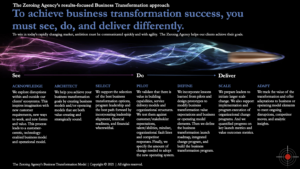
How Do You Transform the Business – A Three Stage | Seven Step Approach

The experiences of leaders that have successfully conducted business transformation, either since or during the global financial crisis of 2008 | global pandemic crisis of 2020, have shown that a three stage | seven step approach to business transformation can lead to success.

Select image to receive a 1-page overview of the approach

STAGE #1 – SEE

STEP #1 – ACKNOWLEDGE

We explore disruptions within and outside our clients’ ecosystems. This inspires imagination with new customer requirements, new ways to work, and new forms and value. This process leads to a customer-centric, technology-enabled business model and operational model.

STEP #2 – ARCHITECT

We help you achieve your business transformation goals by creating business models and/or operating models that are both value-creating and strategically sound.

STEP #3 – SELECT

We support the selection of the best business transformation options, program leadership and the best path forward by incorporating leadership alignment, financial readiness, and financial wherewithal.

STAGE #2 – DO

STEP #4 – PILOT

We validate that there is value in building capabilities, service delivery models and organizational structures. We test them against customer/stakeholder expectations, talent/abilities, mindset, organizational fault lines and competitor responses. Finally, we specify the amount of change needed to adopt the new operating system.

STEP #5 – DEFINE

We incorporate lessons learned from pilots and design prototypes to modify business transformation value expectations and business or operating model elements. Then we define the business transformation launch roadmap, integrated change program, and build the business transformation program.

STAGE #3 – DELIVER

STEP #6 – SCALE

We prepare leaders to initiate larger scale change. We also support implementation and program execution of organizational change programs. And we quantified progress on key launch metrics and value outcomes metrics.

STEP #7 – ADAPT

We track the value of the transformation and offer adaptations to business or operating model elements to meet ongoing disruptions, competitor moves, and analytic insights.

SUMMARY

Times are indeed tough for retailers. But being in a distressed situation isn’t cause for despair. If retail leaders face the facts early, identify and address the root causes of their financial distress, take costs out quickly, and ensure disciplined execution, they can deliver—and rapidly move beyond—a turnaround.

Sam Palazzolo

Filed Under: Blog Tagged With: actionable, business transformation, change management, sam palazzolo, strategy, tactical, tip of the spear ventures

The Language of Business Transformation Leaders

August 4, 2021 By Sam Palazzolo, Managing Director

The Point: You know you need to change, and developing the strategic plan for business transformation is part of the process. At Tip of the Spear Ventures’ consulting firm, the Zeroing Agency, we’ve spent thousands of hours with clients building their business transformation case. But there is an often overlooked aspect to the process — How and what you will say it! So in this post, we’ll explore the language of business transformation leaders… Enjoy!

language of business transformation leaders

Language of Business Transformation

Language of Business Transformation Leaders allows them to share key business outcomes in a clear and compelling manner. Transformative communication is a powerful tool for business executives to facilitate cultural and business change. It can be used for defining a vision, creating a mission statement, and crafting company direction. This facilitates the sharing of strategic objectives and related actions for improving organizational performance. It also empowers business executives with information regarding risks and opportunities for improving business impact and profitability.

The development of transformational language needs to take into account the organization’s culture and values. It should be flexible enough to meet the evolving organizational context. It should also inspire leaders to consider different ways of thinking and acting. In addition, business executives should be capable of communicating effectively and persuasively within a professional context.

Looking to Transform Your Business?

Download your 37 page | 128 question Business Transformation Self-Assessment Workbook!

DOWNLOAD NOW

A Transformational Approach for Business Transformation Leaders

A Transformational Approach is necessary for business leaders to consider different business models and explore different ways of implementing change. It helps them identify business opportunities and evaluate alternatives. It leads business leaders to evaluate their own behaviors and effectiveness in achieving desired business results. It encourages them to develop new skills, enhance their emotional intelligence, and build new networks.

The primary goal of transforming a business is business success. The second goal is avoiding business failure. Transformational language allows business leaders to recognize the difference between the desired business outcome and the possible circumstances that may otherwise arise.

The Language of Transformational Marketing

The language of business transformation helps business leaders think about and act on different business scenarios. The goal of transforming business is to bring about organizational excellence. It also involves creating business solutions and policies to deal with problems of the business environment. To achieve business success, transformational leaders should be able to make the right decisions.

The Mechanics of Transformational Thinking

Transformational thinking can help leaders create the right decision. If a decision does not work out, it should not be continued. Transformational thinking in business therefore helps business managers avoid ineffective actions and select actions that lead to business outcomes. The language of transformational marketing encourages business leaders to be flexible and take corrective action as situations arise. It enables them to overcome obstacles and manage change effectively.

The language of business transformation focuses on the relationships among people within a business. It helps business managers to determine the root cause behind business failures and select the best possible actions to achieve business goals. The focus in transformational thinking is on the long term business outcomes. In the long run, the best business outcome is when the business is run efficiently. It results in the creation of value for the stakeholders.

Transformational thinking in business has the ability to improve the personal and professional lives of business leaders. It empowers business leaders to think critically and act responsibly. Transformational language of business helps business leaders develop and improve their skills and knowledge base. The language of business transformation facilitates communication between different people in a business. It also helps business leaders understand their interrelationships with other people and develop a more strategic approach towards their interactions.

Business Transformation Language that Motivates, Inspires & Attracts

Transformational thought processes to support collaborative problem solving and seek to establish clear targeting of future goals. They promote trust, build internal strengths and create a positive image. Transformational thinking and language of business have the ability to create positive images that motivate, inspire and attract followers. Transformational thinking and language of business help business leaders to plan for and achieve future business outcomes. It is an important component of business success.

A business outcome cannot be determined by a single decision. It is determined by a series of decisions and actions taken in a particular business environment. In order to make a business outcome happen, the planning process requires a commitment of time, energy and resources. Language of business transformation facilitates collaboration among business stakeholders, resulting in the adoption of important business decisions.

Language of business transformation can be used to describe and measure a business’ performance. The value of transformational thinking and language of business is evident in the fact that they are used not only by business leaders but also by ordinary employees. It has the ability to create harmony and understanding among people. The results of successful language of business transformational processes can be seen in increased productivity, improved employee relations, and an overall sense of satisfaction and fulfillment. A business needs extensive communication with its employees and external business partners in order to reach its business outcome.

SUMMARY

The Language of Business Transformation Leaders help them to lead their organizations successfully by building an inclusive culture, which is comprised of everyone from the boardroom to the frontlines. An inclusive culture is one in which everyone is invested in the success of the business and works together as a team to achieve business goals. Language of business transformation facilitates communication, promotes trust and understanding. It provides individuals with the ability to communicate about problems in a constructive manner and encourages them to contribute to the growth of the business.

Sam Palazzolo

Filed Under: Blog Tagged With: business case, business outcomes, business transformation, business transformation language, change, change management, language of business transformation leaders, leadership, risk mitigation, success measurements

Business Transformation for Post-Pandemic Success – Ten Tips!

August 1, 2021 By Sam Palazzolo, Managing Director

The Point: At Tip of the Spear Ventures, we’ve seen firsthand how leaders can get into crisis situations without realizing that they are getting worse. They are not bad leaders. But these leaders often work under outdated paradigms and let the power of inertia take them along. If they don’t recognize that they’re in crisis, they won’t be able to realize that they must make a business transformation. Under normal circumstances this leads to poor performance, and as we exit the pandemic doing so will definitely lead there. So, in this article we’ll explore business transformation for post-pandemic success along with ten tips… Enjoy!

business transformation for post-pandemic success

Business Transformation – Bad Leadership?

We all have heard the same regrets from leaders regarding why they failed to transform their business. Sometimes leaders underestimated the severity of their situation or were looking at incorrect data. Some took advantage of cheap capital to keep going despite poor performance and believed they could pull it off. Others got so focused on short-term returns they forgot to protect their company’s long term health, or even willingly sacrificed it.

Rarely is there a leader who takes the time to look at his or her plans objectively and asks, “Where are we going? Is this what will happen when we start down this path?” This is a problem, because admitting that your plan isn’t going to work/working is an important first step.

These then are the ten best ways for ailing businesses to get started on business transformation for post-pandemic success.

Looking to transform your business?

Download our 37 page | 128 question Business Transformation Self-Assessment Workbook!

DOWNLOAD NOW

Tip #10 – Don’t be Influenced by the Business Transformation

It is almost impossible to find a single definition of a company that is in need of transformation. And it can be dangerous to believe you might be in need of transforming your company. There are likely to be 25 business transformation signs depending on the situation. However, the problem is rarely made up of only one or two of these signs. It is more likely that a larger number of these things interact with each other and with external factors.

Tip #9 – You Must be Honest with Yourself about Your Plans

You can avoid most business transformation stress by reviewing your business plans regularly. You should include trigger points in your business plans, regardless of whether you are creating them at the beginning of the year, or at the beginning of a 3-year cycle. One simple reminder is enough: “If we don’t achieve this level of performance or the 12 items below by the deadline, we will step back and evaluate whether we are on the right track, considering what has happened since our last review.”

These trigger points should be oriented to both operational and market performance, as well as basic financial metrics and cashflow. Take a look at your company’s financial and cash milestones and compare it to the industry and other competitors. Your plan might be outdated if you are not moving along with the industry or outpacing it if the industry’s in trouble. To identify trends, look back at past cycles and examine your performance. Ask yourself why you aren’t meeting your performance goals.

Tip #8 – Expect More from Your Advisors

An advisor has enough distance to see the forest from the trees. This is the beauty of an objective advisor. However, leadership tends to view their advisors as a “necessary evil” that they must placate in order to get on with their businesses. This undermines the advisors role as an early-warning system for companies heading for business transformation trouble.

The advisors must also look at the CEO, CFO and chief operating officer (COO), and say “OK, we like the plan. Let’s now discuss what it would take not only to reduce costs by 3 percent, but also by 20 percent. Let’s discuss all the possible risks that could happen to the business.” While there is no typical business transformation situation, the company may have had only 18-24 months of poor performance and the advisor hasn’t been able to ask the right questions. This is where advisors can have a significant impact.

One company’s senior management team keeps a list of all business transformation risks that could affect the business, employees and plan. The advisors review these risks on a quarterly basis. This is a great way to have conversations you might not normally have with other people in your business.

Tip #7 – Cash is Your Priority!

The key to a successful business transformation is not about cash or cash returns, but rather focusing on cash as a whole. This means that a business must return to its core element of success. Are they generating or burning cash? What investments are making or losing cash in the business?

Here’s an example as if you were running an e-commerce (Electronic Commerce) store. You will want to ask fundamental questions such as: Is there enough cash in the register for the utility bill? Or to pay for the pallets of paint that will arrive next week? How much cash can I make by buying a new delivery truck? The actions required to get your business back on track are clear when you return it to its core elements. Many of the cases are focused on complicated metrics such as earnings before interest and tax (EBIT) or return on investment, which excludes major cash uses. Variations on EBIT, for example, often exclude amortization and depreciation but exclude rents and fuel. All these metrics are great, but there are always unpleasant surprises when you’re not focusing on cash.

Cash management is more than just keeping track of your bank balance. Leaders need to have a forecast that is both long-term and mid-term in order to avoid unexpected expenses. Companies are often end up in trouble if they fail to consider the cash component of capital investment. The projected net present value (NPV) can be the same regardless of whether the return is gradual, at year two, or dramatic at year five. If you don’t pay attention to the cash flowing out of the business while you wait for the year-five injection, you could find yourself in a situation where you have very little cash left. This could lead you into a downward spiral that you might not be able to recover from.

Tip #6 – Make a Difference with Your Business Transformation Story

Companies in business transformation fail to create a story about change that everyone can understand, which gives rise to a sense of urgency. Here’s an example: As chief restructuring officer for a SaaS technology company, we did a business transformation engagement. It was profitable, it returned a decent margin and it was cash-positive. The commodity price was falling and the advisors were concerned about the ability to generate enough cash flow to support capital requirements. We created a change story that said “Yes, we’re profitable. The whole point of profitability, however, is to have enough cash to grow and expand operations. If that isn’t possible, we are headed for a slow, steady decline in which equipment fails and lower production becomes the new reality.”

People will listen if you tell the story in one paragraph. Team members wanted their children and grandchildren to work for the same technology company. The change story inspired them to take action so that could become reality. The key to success was simple messaging and not fancy metrics.

Tip #5 – Every Business Transformation should be Treated as a Crisis

A stable company will respond to business transformation changes without a crisis mindset. Risk is to be avoided and incrementalism takes control. Your employees are expected to do more with less. You will see more aggressive ideas and slower implementation.

A business transformation crisis, however, requires immediate action. This is exactly what a distressed business needs. Leaders must use the words “crisis” and “urgency” as soon as they realize the need for business transformation. In a true crisis, a company will try things it wouldn’t normally consider. These bold actions can change the company’s trajectory. Leaders are encouraged to explore all options when faced with transformation.

Tip #4 – Quick Wins Can Help You Build Traction for Positive Change

Leaders tend to focus all their attention and resources on a few big bets to save a company in business transformation. This can lead to unnecessary high-risk decisions. Even though big bets may sometimes be necessary, they can take a lot more time and effort than they pay off. Imagine that you change your suppliers of raw material to source from a lower-cost country. You expect 35 percent lower direct cost. You’ll probably spend a lot of time and money on something that didn’t work out.

Leaders should not only focus on making big bets but also work hard to get traction in the company. These quick wins can be cost-focused, reducing the demand for an external service that they don’t require. It could also be policy-focused, like introducing stricter expense policies.

These moves not only improve the bottom line but also create support among team members. You’re almost certain to find support from twenty percent of employees in any company. They are hard workers. They will make changes if you ask. These are the people that you will want to spend the most time with and the ones you will promote. However, you may spend too much time working with the bottom twenty percent of employees. These people are low-achieving and resist change. They also look for ways to avoid it or are just difficult to lead.

The remaining 60% of the company is often overlooked. They are the fence-sitters and are tuned to action, not talk. These people see the changes happening and will support you if you work with them. If you don’t give them reasons to be positive about the company they will turn against you. This is why it’s important to make quick wins. You send a strong message when you take immediate action and those actions have an impact on the leadership team.

Tip #3 – Get Rid of Your Old Incentive Plans

In many cases, incentives are the most overlooked aspect of business transformation. Short-term incentive plans for stable companies can include a variety of goals that address safety, financial, operational, and personal performance. Many of these plans are so complicated that leaders often shrug when asked what they should do to earn their bonus. Why? They can’t figure it out!

Take a cue from the private equity industry — The other side of our firm at Tip of the Spear Ventures — to help you make a successful business transformation and ditch your old plans. Instead, give managers incentives that are specific to the things you want. Are you looking for $15 million in price improvement? Make it part of your incentive program for marketing and sales team members. You need $100 million in procurement. Your chief purchasing officer should set a goal. If they don’t reach their goal, be willing to forgo bonuses and pay handsomely to those who do (Skin in the game!)

Tip #2 – Business Transformation Turnover in Leadership

Our Business Transformation experience has taught us at Tip of the Spear Ventures that the best transformations are those where one or two of the top-team members are replaced. This doesn’t mean that there are “bad” leaders. In our experience, we have only encountered a handful of leaders that we considered truly incompetent. It’s not a reality, but there are still leaders who have to accept the decline. They are often incapable of making fundamental changes in the operating philosophy that they have believed for many years. They block the business transformation change, whether they realize it or they don’t. This is because they are determined to defend what they believe is true. It’s not easy, but it sends a signal to your stakeholders that you are willing to make hard moves and change.

Tip #1 – Hire, Train, and Retain the Talented

There are two types of talent that we look for, and they go beyond the leadership team. The first is those who have institutional knowledge. Although they may not be the top performers, they are able to understand the company’s intricacies. This knowledge is crucial for understanding the potential impact of any business transformation changes on the business. They are often the ones who are unhappy about the company’s performance. You need people who will be open to sharing the “unpleasant truths.”

Business Transformations are also an opportunity to identify the next generation of talent within an organization. Multiple crises have brought us to the realization that the people who had the greatest impact and added most value weren’t always the ones at the top. Sometimes, we find great leaders at the second and third levels who are waiting for an opportunity. The fact that they can save a company and be part of something greater than themselves is enough to keep them around and motivate them for even more!

SUMMARY

In this article we’ve explored business transformation for post-pandemic success along with ten tips. While there are no identical business transformations in organizations even in the same industry sector, there are similarities in the business transformation mistakes that can be learned and not repeated.

Sam Palazzolo

Sam Palazzolo — Tip of the Spear Ventures’ Managing Director — has been managing business transformation programs for over 20 years. He knows that even the best leaders overlook signs of distress, typically because they don’t recognize that there is a problem!

Filed Under: Blog Tagged With: business process transformation, business transformation, post-pandemic success, sam palazzolo, tip of the spear ventures

  • « Go to Previous Page
  • Page 1
  • Interim pages omitted …
  • Page 32
  • Page 33
  • Page 34
  • Page 35
  • Page 36
  • Interim pages omitted …
  • Page 90
  • Go to Next Page »

Primary Sidebar

Related Content

  • Why Price Objections Aren’t Really About Price
  • The RCM Wheel Is Lying to You
  • McKinsey’s AI Workforce Shift
  • The NIL Playbook for High-Velocity, High-Impact Growth in the Attention Economy
  • Getting Clarity on AI ROI: You’re Looking at It All Wrong
  • AI + Ivy Lee: The Productivity Hack You Didn’t Know You Needed
  • How AI Is Rewriting SaaS Economics

Search Form

Footer

Ready to Scale?

Download Sam Palazzolo’s ’50 Scaling Strategies’ eBook ($50 value) for free here…
DOWNLOAD NOW

Copyright © 2012–2026 · Tip of the Spear Ventures LLC · Members Only · Terms & Conditions · Privacy Policy · Log in