The Failure Point Most Leaders Miss
Most decisions do not fail because they are wrong. They fail because they do not survive translation.
A leadership team aligns around a strategy. The logic is sound. The direction is clear. But as that decision moves across functions, layers, and incentives, it begins to degrade. Priorities blur. Assumptions shift. Execution fragments.
What started as a coherent decision becomes a series of interpretations.
This is not a failure of strategy. It is a failure of clarity: the inability to preserve a decision’s logic as it moves from conception to execution.
In practice, this breakdown is both common and costly. Sales teams communicate different versions of the same value proposition. Functional leaders pursue competing priorities while believing they are aligned. Capital narratives shift depending on the audience, eroding credibility with investors.
Each issue appears isolated. The underlying failure is not.
A3 Is Not a Document. It Is a Discipline.
Toyota developed a mechanism designed to address this exact failure point. Known as A3, it is commonly described as a one-page report. That description is directionally accurate but fundamentally incomplete.
A3 is not a document. It is a discipline that forces clarity before a decision ever leaves the room.
At its core, A3 imposes a simple constraint: the entire problem, analysis, decision, and plan must fit on a single sheet of paper. This constraint is not about brevity for its own sake. It is about forcing precision. Leaders are required to define the problem in concrete terms, ground their understanding in observable conditions, identify root causes rather than symptoms, and articulate countermeasures that logically connect to those causes.
The sequence matters. The logic must hold. There is no space for ambiguity or excess.
If you cannot explain the decision on one page, you do not yet understand it well enough to execute it.
Sam Palazzolo
Why Decisions Break Down in Practice
Most organizations do not lack intelligence or effort. They lack a shared, disciplined method for converting ideas into clear, transferable logic.
As a result, alignment becomes superficial. Teams may agree in conversation but do not operate from a common understanding. Each function fills in gaps independently, introducing variation at every handoff. Over time, these small deviations compound into material execution failure.
This pattern is particularly visible in high-stakes environments. In growth-stage companies, leadership teams often believe they are aligned on priorities, yet execution reveals competing interpretations. In capital markets, founders present narratives that shift across meetings, signaling a lack of underlying coherence. Investors and operators respond not to the stated strategy, but to the inconsistency behind it.
These are not communication issues in the conventional sense. They are failures of narrative integrity. The underlying logic of the business is not consistent enough to carry across audiences without distortion.
The Role of Constraint in Forcing Clarity
A3 addresses this problem by standardizing how thinking is structured and communicated.
A well-constructed A3 does not simply describe a decision. It makes the reasoning behind that decision explicit and testable. The problem is clearly defined. The current condition is grounded in data and direct observation. Root causes are identified through structured analysis. Target outcomes are specified. Countermeasures are directly linked to those causes. An execution plan assigns ownership and timing.
Because all of this is captured in a single, coherent view, the decision becomes portable. It can move across teams and levels without being reinterpreted at each step. The integrity of the logic holds.
Constraint is what enables this. By limiting space, A3 eliminates the ability to hide behind complexity or defer clarity. It forces leaders to resolve ambiguity at the point of decision rather than allowing it to surface during execution.
Most execution failures are not operational. They are failures of clarity that compound over time.
Sam Palazzolo
PDCA Is the Engine Inside A3
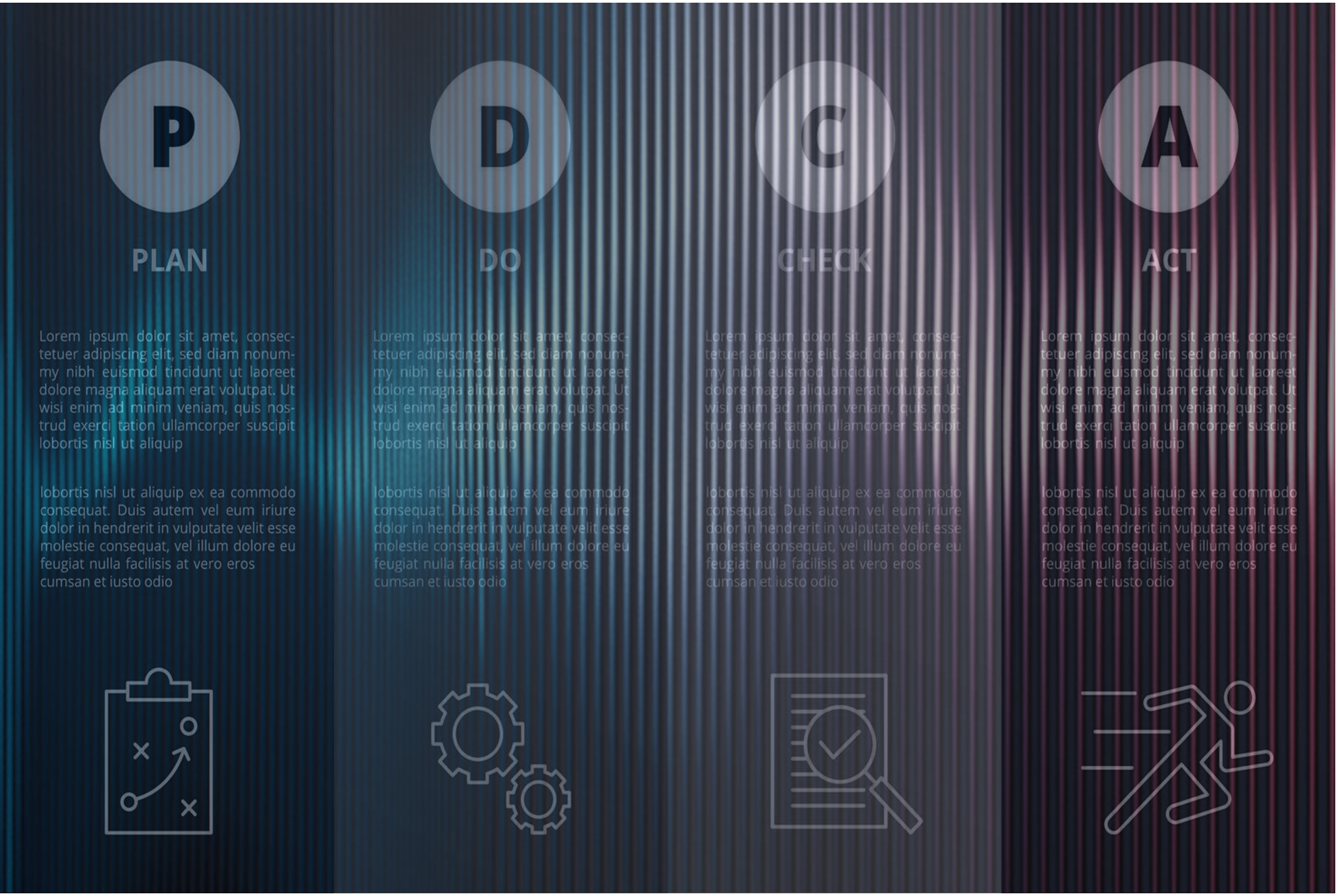
A3 does not produce clarity by accident. It produces clarity because PDCA is built into its structure.
Plan, Do, Check, Act is the thinking sequence that governs how a well-constructed A3 moves from left to right. The left side of the page is the Plan phase: problem definition, current condition grounded in direct observation, root cause analysis, target condition, and proposed countermeasures. This is where the discipline is most demanding, and where most organizations cut corners by moving to action before the thinking is complete.
Do is the execution plan: specific actions, clear ownership, defined timing.
Check is where most organizations fail. A3 requires a follow-up review: did the countermeasures produce the expected result? Without this step, execution becomes a one-way door. There is no mechanism to learn, no feedback loop to close.
Act is the final phase: if the countermeasures worked, standardize them. If they did not, return to the Plan phase with new information and a sharper hypothesis.
This is why A3 functions as a translation tool rather than simply a reporting format. PDCA enforces a complete thinking cycle. The single-page constraint makes that cycle visible and auditable. Every reader of the A3 can see exactly where the logic holds and where it does not. Gaps cannot be hidden behind slides, narrative, or volume.
Most organizations complete Plan and Do, then move on. A3 treats Check and Act as non-negotiable. That is where institutional learning lives, and it is where most execution disciplines fail to close the loop.
From Factory Floor to Boardroom
Although A3 originated within manufacturing, its relevance today extends well beyond the factory floor.
Across SaaS organizations scaling from $5 million to over $500 million in revenue, through private equity-backed transformations, and in capital raise processes, the pattern is consistent. Where A3 discipline is present, decisions move faster, alignment is more durable, and execution is more consistent. Where it is absent, organizations compensate with more meetings, more documentation, and more oversight. None of those measures address the root issue.
This is not about Lean as a philosophy. It is about clarity as a competitive advantage. In environments where speed and precision matter, the ability to maintain a consistent, defensible narrative across stakeholders is a differentiator.
Why Leaders Resist It
Despite its effectiveness, A3 is often resisted, particularly by experienced leaders.
The discipline removes the ability to rely on abstraction, to substitute volume for clarity, or to defer thinking to later stages. It exposes gaps in understanding quickly and publicly. For leaders accustomed to operating through discussion rather than structured reasoning, this can feel constraining.
That constraint is precisely the point. By forcing clarity early, A3 prevents misalignment from compounding later, when the cost of correction is significantly higher.
The Test of a Decision
Most organizations do not struggle to generate ideas. They struggle to preserve them.
A decision may be sound at the point of origin. But if its logic cannot survive movement across the organization, it will degrade into interpretation. And interpretation is where execution breaks down.
This is the problem A3 was designed to solve. By forcing clarity at the source, it ensures that decisions can move without losing their integrity.
Because in any organization of scale, the test of a decision is not whether it was right when it was made.
It is whether it survives translation.
Sam Palazzolo, Managing Director, Tip of the Spear Ventures | Founder, The Javelin Institute
12+ years ago I led a Tech (SaaS) startup to PE exit. Since, I have scaled 15+ organizations from $5M to $500M (2x $1B+).
References
- Sobek II, D. K., & Smalley, A. (2008). Toyota’s Secret: The A3 Report. MIT Sloan Management Review, 50(1), 17–24. https://sloanreview.mit.edu/article/toyotas-secret-the-a3-report/
- Sobek II, D. K., & Smalley, A. (2011). Understanding A3 Thinking: A Critical Component of Toyota’s PDCA Management System. Lean Enterprise Institute. https://www.lean.org/Bookstore/ProductDetails.cfm?SelectedProductId=349
- Lean Enterprise Institute. (n.d.). A3 Thinking and Problem Solving. https://www.lean.org/explore-lean/a3-thinking/
- Liker, J. K. (2004). The Toyota Way: 14 Management Principles from the World’s Greatest Manufacturer. McGraw-Hill.
- Sutton, R. I., & Rao, H. (2014). Scaling Up Excellence: Getting to More Without Settling for Less. Crown Business. (See also: “Why Great Innovations Fail to Scale,” Harvard Business Review.)
- Rumelt, R. P. (2011). Good Strategy/Bad Strategy: The Difference and Why It Matters. Crown Business.