• Skip to main content
  • Skip to primary sidebar
  • Skip to footer

Tip of the Spear Ventures

A Family Office that behaves like Venture Capital | Private Equity | Business Consulting

  • Advisory Services
    • BRANDING & GTM
    • BUSINESS GROWTH
      • PE & VC Portfolio Growth
      • Executive Coaching for PE & VC
    • VENTURE FUNDING
      • Capital Raise & Network Access
    • M&A
  • FO Direct Investments
  • The Point Blog
  • Contact Us
  • FREE eBOOK

sam palazzolo

Five Tips For Becoming an Entrepreneurship Through Acquisition

March 4, 2021 By Sam Palazzolo, Managing Director

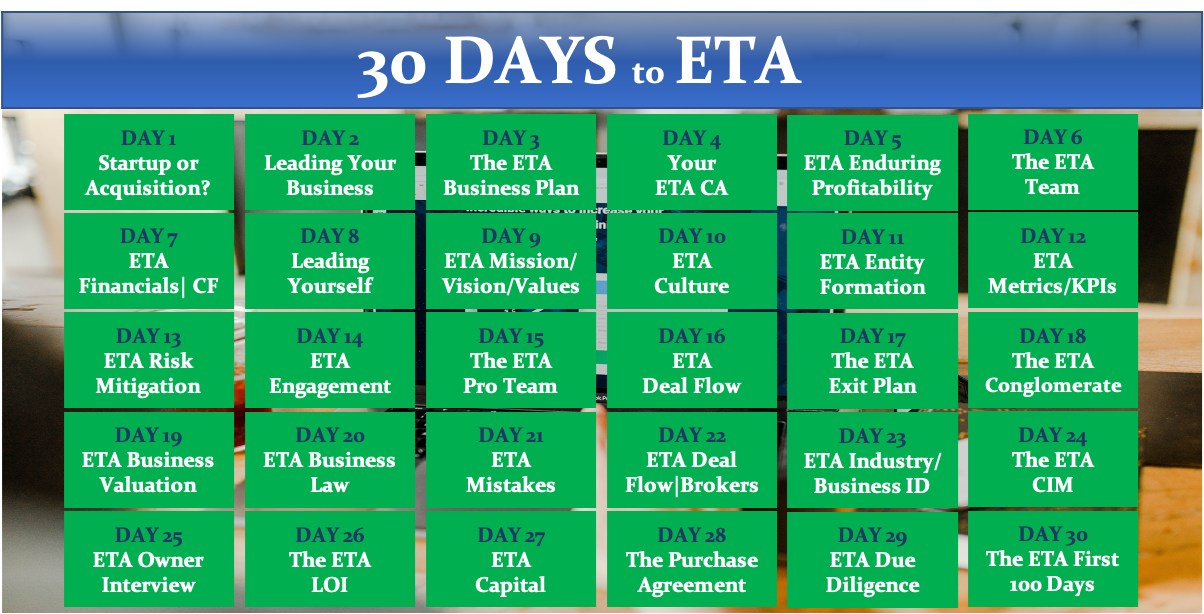
The Point: Being an entrepreneur is great! However, the saying, “Work smart!” should be a tactical advantage with a strategy of buying a business being front/center! I see time and again entrepreneurs that start a business from scratch — and that’s just plain hard work! In this post we’ll explore Five Tips For Becoming an Entrepreneur Through Acquisition (ETA)… Enjoy!

You do not need to begin a new business from scratch in order to become an entrepreneur. In fact, purchasing a company with which you are familiar could be a wiser choice. Creating, marketing, and then selling companies are all a part of your entrepreneur s journey. There are certain things you will want to keep in mind when looking into purchasing a company, though. Below are four tips for becoming an entrepreneur through acquisition.

Tip #1 | Entrepreneurship Through Acquisition

The first and most important step to becoming an entrepreneur is being able to finance your business. Financing is crucial to making any business work, but it is even more critical when you are just starting out. If you are working with a limited budget, your options may be limited. In order to get everything lined up, you will want to begin working with a lender as soon as possible, particularly if you intend to use credit cards or other forms of capital. When you are seeking seller financing for your business, you will have to provide substantiation of your income, a solid plan for increasing your sales, and a clear plan for paying back the loan.

Tip #2 | Entrepreneurship Through Acquisition

The second step in becoming an entrepreneur through acquisition is finding a seller financing program. Most traditional banks do not look favorably on businesses that have never made a profit or do not have a history of revenue. In order to get everything lined up for your business, you will have to secure funding from either a bank or a private investor. A good real estate investor will be especially helpful because he or she can get you loans with a lower interest rate than what you can get from a bank.

Tip #3 | Entrepreneurship Through Acquisition

The third tip to becoming an entrepreneur through acquisition is to make sure you can make a profit on your investment after your first acquisition. The ideal scenario would be to purchase a business with low start up costs and high revenue potential. Most businesses fail shortly after they are launched. If you cannot turn a profit on the first sale, you may have to take a loss on every sale thereafter until you break even.

Tip #4 | Entrepreneurship Through Acquisition

The fourth tip to becoming an entrepreneur through acquisition is to consider a gradual increase in profits over time. An entrepreneur does not simply buy a business with the best potential for revenue and expect a huge windfall from it the next day. Business development takes time and effort. Your job during the early stages of your business venture is to generate customers and build a strong relationship with your suppliers.

Tip #5 | Entrepreneurship Through Acquisition

The fifth and final tip to becoming an entrepreneur through acquisition is to consider starting your own company as a small business. When you start your own business, your goal is to have low start up costs, high annual revenue, and a strong customer base. This means you will have a limited amount of resources to work with in terms of finances. Starting your own business can be extremely difficult if you do not have a comprehensive business plan in place. You must set a budget and identify your target market to determine how much money you can invest in your new business venture.

SUMMARY

In this post we’ve explore Five Tips For Becoming an Entrepreneur Through Acquisition (ETA). If you’re ready to put the strategic advantage of acquisition — buying a business — to work for you instead of starting one from scratch, success is still going to be hard work. However, the outcome can be much more advantageous.

Sam Palazzolo

Filed Under: Blog Tagged With: acquisition entrepreneurship, Buy a business, Entrepreneur journey, Entrepreneurship through acquisition Entrepreneur journey Acquisition entrepreneur, sam palazzolo

9 Lessons In 9 Years at Tip of the Spear Ventures

February 1, 2021 By Sam Palazzolo, Managing Director

February 2012 – I am a 2%’er. Apparently, and I wouldn’t know this until later (much later!) that less than 2% of all entrepreneurial startups achieve successful exit. The experience of raising $8Million, launching a technology software startup that received consumer traction, and having a private equity firm acquire us was incredible! But now what? As I sat on a rock overlooking the ocean in San Diego, CA, I thought back to how it was just 7 years earlier that I had done the same to envision what was to come. “Now what?” was the question I was asking myself again, looking to the horizon where the sky meets the Pacific.

I knew that I enjoyed the private equity experience, and after a few moments determined that was what I wanted to do next. I wasn’t a total stranger to the financial space, having my formal education in Accounting and spending my formative years working in Strategic Planning and Finance. In the 9-years since that day, I’ve built something that I’m very proud of and I’d ike to share with you 9-lessons I’ve learned along the way.

Lesson #1 – Define Your “What?”

What are you made of and what do you offer? This is the “metal” that has been tested at Tip of the Spear everyday. We’ve “pivoted” over the years with different ventures, but the one mainstay was that we are “what” others should desire to be (Namely a group that puts forth A+ effort and content deliverables).

Lesson #2 – More People, More Problems

If you’ve hired as a part of your leadership journey, you know the pitfalls that can come with doing so. We’ve been at different times over the 9-years a small and big organization. I’m happy to say that we’ve settled on a model for the future that includes clustered growth. 

Lesson #3 – Think Strategically, Act Tactfully

In the heat of business, I want to win. I assume you do as well. However, and this was key for me, those “win” moments or victories that I sought to win were often at the expense of the war. I was reminded to think strategically and to act tactfully by an executive coach. The difference in thought/action appears in everything we do now.

Lesson #4 – It’s Lonely at the Top

I originally had a partner at Tip of the Spear Ventures. They were a silent partner that was low on injecting capital, but high on injecting their opinion. At about the three year mark we determined that parting company was best for the company (and us as individuals). I would rather be lonely than miserable.

Lesson #5 – It’s Lonely (but Don’t Go It Alone!)

This piggybacks off of Lesson #4… Even though you’re alone at the leadership helm of your firm/organization, you don’t need to go it alone! While opinions are like you know whats, if you tactfully align with peers/mentors you’ll achieve desired strategic outcomes faster.

Lesson #6 – Change Lives!

Opportunities to make money are everywhere, especially if you look for them! What might be even less obvious is the ability to change lives. I’ve been fortunate to receive recognition that what I was doing was actually making a difference for the people that I worked with. It is simultaneously humbling and rewarding.

Lesson #7 – Time… 

You, me, everyone only has 24-hours in a day. What are you doing with it that maximizes your efforts?

Lesson #8 – Agility

While processes and procedures form the structure of a successful business, the ability to be agile is a key differentiator. Want to stand out from the crowded crowd? Become agile!

Lesson #9 – It takes Blood, Sweat, & Spears!

I sometimes have to pinch myself… I’m a city kid from Detroit that was as my Mother says “Born in the shadow of a Ford manufacturing plant’s smokestack.” How far I’ve come has only been limited by my ability to imagine, visualize, and then take action. At one of our Boot Camps a few years back in Las Vegas, one of the participants accurately summarized that “Success takes blood, sweat, and tears!” The conversation morphed to one of “Blood, Sweat, and Spears!” which has stuck with us ever since (We’re running another Boot Camp starting 2.21.2021 for those seeking Entrepreneurship Through Acquisition). 

SUMMARY

These past 9-years have taught me so much, and I know that the next year will be even more insightful.  I’m determined to further establish in our ninth year the foundation that will drive the firm forward for the next two decades. I recognize that what worked in the past might not necessarily work in the future, so we will have to continue to evolve.  It is my goal to build an institution that outlasts me and continues serving entrepreneurs for generations to come. 

Sam Palazzolo

Filed Under: Blog Tagged With: entrepreneur, entrepreneur through acquisition, sam palazzolo, startup, tip of the spear

Do You Really Need Venture Capital?

January 12, 2021 By Sam Palazzolo, Managing Director

The Point: “Do you really need venture capital?” is a question that we’re typically asked at Tip of the Spear Ventures, regardless of the organization is lead by entrepreneurs in a startup pursuit or an existing entity. The short answer is “No!” The long answer, well that’s a “No” too… In this post, we’ll explore the question do you really need venture capital… Enjoy!

Would you be surprised to learn that the majority of companies, successful companies, never took a dime from a venture capital firm? Companies on the Inc. 5000 in the USA, the Fast Track 100 in the UK, and similar lists everywhere didn’t follow what most would be consider the “conventional” script when it came to funding their business.

What did these organizations do then to raise capital? The huge majority of them never obtained a pound or dollar or rupee of venture funds, and they did not guarantee or mortgage their houses in the process. Rather, they were able to find ways to achieve getting their businesses up and running, then growing, without pandering to VCs or groveling to their company’s CFO.

These organizations accomplished their business funding goals by simultaneously solving pressing consumer problems, or by creating delightful customer experiences that transformed the previously mundane business that was present. Most of these entrepreneurs constructed vibrant, growing businesses without increasing treasure troves of venture capital.

“Where did their business funding come from?” you might ask. The lion’s share of these got almost all of the money–initially, at least, and sometimes for the whole journey–from a much more hospitable and agreeable source: their customers.

Sam Palazzolo

If you, or your organization are exploring Business Funding options, please drop us a line at info@tipofthespearventures.com.

Filed Under: Blog Tagged With: business funding, customer funding, raising capital, sam palazzolo, tip of the spear ventures, venture capital

Business Funding – Subscription Models

January 7, 2021 By Sam Palazzolo, Managing Director

The Point: We’re often asked at Tip of the Spear Ventures, “What are the best ways to go about business funding – Should we consider subscription models?” The short answer is “Yes.” Subscription models are yet another way to accomplish business funding over a traditional capital raise. So in this article we’ll explore business funding through the use of subscription models… Enjoy!

Small business funding refers to the way in which an aspiring or already existing business owner obtains cash to launch a new business, buy an existing business or increase capital to finance future business activity. Business funding can come in many forms, but the most common sources are angel investors, venture capitalists or third party lenders. Entrepreneurs looking for startup capital should take note that all investors are not created equally and each has different goals and business needs. So it begs the question, “Why not explore customer funding options, specifically subscription models?”

Entrepreneurs should consider carefully how they plan to use any business financing options and should always have a game plan before approaching a private investor or a bank. Often it’s the case that entrepreneurs don’t even need to approach an outside funding source. A number of private investors offer startup capital at a discounted rate to entrepreneurial risk candidates who possess a well-developed business plan, a strong personal credit history and a steady track record of profit and loss repayments. To attract and qualify for such financing, entrepreneurs need to demonstrate a strong business plan with a well thought through exit strategy. Additionally, entrepreneurs should develop a set of metrics to track key metrics such as customer satisfaction, profit margins and return on investment.

When it comes to small business funding, entrepreneurs should also keep in mind that there are several options available to them. There are many different types of startup loans including bank loans, credit unions, commercial real estate loans, equity loans from family members and friends, working capital options from multiple lenders and lastly, entrepreneurs can tap prepaid credit cards as working capital. While some entrepreneurs may have better success securing business funding through more traditional means, most borrowers fail to secure enough capital to launch or expand their operations. There are several successful stories of entrepreneurs who obtained small business funding on a shoe string budget. If you have the desire and the ability to be financially secure and succeed in the entrepreneurial business environment, then you may want to consider applying for funding from a private lender. All of this said though, an avenue to pursue before doing so is the applicability of a subscription model as a way of raising capital for your enterprise.

Sam Palazzolo

Filed Under: Blog Tagged With: business funding, entrepreneur, raising capital, sam palazzolo, small business, subscription model, tip of the spear

Business Funding – Bootstrapping

January 5, 2021 By Sam Palazzolo, Managing Director

The Point: We’re often asked at Tip of the Spear Ventures, “What are the best ways to go about business funding – Is Bootstrapping an option?” The short answer is “Yes.” Bootstrapping is just one way to accomplish business funding, but it also has the most heartache or ramen diet attached to it. So in this article we’ll explore business funding through bootstrapping… Enjoy!

Small business funding refers to the means by through which an aspiring or already existing business owner gets enough money to begin a new business, buy an already existing business or finance future business activity. A small business is usually defined as a business that earns less than $10 million per year and employs fewer than 100 employees. This definition does not necessarily mean that small businesses have a low income or are considered unprofitable. Small businesses can be very successful, and many small businesses are able to become profitable even with relatively small capital investments.

Bootstrapping, on the other hand, refers to using existing resources (cash) to launch a business. Bootstrappers typically start with personal savings or credit cards to obtain the funding they need to launch their business. These loans are typically secured loans, meaning that they require collateral in the form of personal assets or property owned by the borrowers.

There are many small business funding options available to small businesses in today’s economy. Most angel investors and venture capitalists prefer to invest in well-established businesses with proven track records and a good track record of success (revenue). The more risk involved, the less likely these investors are to provide business funding in raw form, such as business loans. However, even in the absence of venture capital and angel investors, there are numerous other sources of funding available to small businesses, including personal savings, business loans, credit cards, small business investment funds, lease option funds, business franchises and subcontractor companies.

Sam Palazzolo

Filed Under: Blog Tagged With: bootstrapping, raising capital, sam palazzolo, small business, tip of the spear ventures

  • « Go to Previous Page
  • Page 1
  • Interim pages omitted …
  • Page 38
  • Page 39
  • Page 40
  • Page 41
  • Page 42
  • Interim pages omitted …
  • Page 56
  • Go to Next Page »

Primary Sidebar

Related Content

  • Getting Clarity on AI ROI: You’re Looking at It All Wrong
  • AI + Ivy Lee: The Productivity Hack You Didn’t Know You Needed
  • How AI Is Rewriting SaaS Economics
  • The AI Leadership Popularity Contest
  • From Confusion to Clarity: AI Adoption Strategies
  • The AI-First Organization: Redefining Workflows, Talent, and Leadership for the Next Era
  • Customer Funding: Venture Funding’s Overlooked Option

Search Form

Footer

Ready to Scale?

Download Sam Palazzolo’s ’50 Scaling Strategies’ eBook ($50 value) for free here…
DOWNLOAD NOW

Copyright © 2012–2025 · Tip of the Spear Ventures LLC · Members Only · Terms & Conditions · Privacy Policy · Log in