• Skip to main content
  • Skip to primary sidebar
  • Skip to footer

Tip of the Spear Ventures

A Family Office that behaves like Venture Capital | Private Equity | Business Consulting

  • Advisory Services
    • BRANDING & GTM
    • BUSINESS GROWTH
      • PE & VC Portfolio Growth
      • Executive Coaching for PE & VC
    • VENTURE FUNDING
      • Capital Raise & Network Access
    • M&A
  • FO Direct Investments
  • The Point Blog
  • Contact Us
  • FREE eBOOK

sam palazzolo

Why Price Objections Aren’t Really About Price

March 18, 2026 By Tip of the Spear

Price objections show up in almost every sales conversation. A buyer leans back and says, “This is expensive.” In that moment, most salespeople make the same mistake. They assume the objection is about price. They respond by justifying their fee, offering concessions, or attempting to negotiate toward a middle ground.

From my experience sitting in the Chief Revenue Officer (CRO) seat and advising growth-stage companies through hundreds of these conversations, that instinct is consistently wrong. Price objections are rarely about price. In most cases, they signal something more fundamental: the buyer does not yet see the decision as a justified investment. The issue is not the number itself. It is how the value behind that number has been framed, quantified, and understood.

This distinction between price and value matters. When price objections are treated as a negotiation problem, the outcome is predictable: discounts, margin erosion, and stalled decisions. When they are treated as a framing problem, the conversation changes. The objective is no longer to defend the price, but to redefine how the decision is evaluated.

Price Pressure Starts with How Value Is Framed

Every buying decision operates within a frame. When a solution is presented as a cost, the buyer evaluates it accordingly. It is compared against a budget. The default objective becomes minimizing spend. The question becomes, “Can we afford this?”

Under that logic, pushing back on price is rational. But when the same solution is positioned as an investment, the evaluation changes. The buyer considers expected return. The objective shifts from minimizing cost to maximizing outcome. The question becomes, “Is this worth it?”

The numbers have not changed. The decision logic has. Research in behavioral economics shows that people evaluate identical outcomes differently depending on how they are framed (see Daniel Kahneman’s extensive work on the topic). In a sales context, that effect is amplified. If you allow the conversation to begin—and remain—in a cost frame, you should expect price pressure to follow.

The Real Issue: Lack of Quantification

Even when salespeople attempt to position value, they often stop short of making it usable. Buyers rarely reject clear, credible value or return on investment (ROI). They reject ambiguity. Consider how value is typically communicated:

  • “We’ll improve efficiency”
  • “We’ll help you grow revenue”
  • “We’ll reduce risk”

While all might be directionally true, none are buyer decision-ready. Without quantification, the buyer cannot build an internal case (Finance cannot validate it, leadership cannot prioritize it, etc.) The sales conversation defaults back to what is concrete: price.

Effective operators close this gap by anchoring value in three variables:

  1. What metric changes (revenue, cost, time, risk)
  2. By how much (a defensible range, not a guess)
  3. Over what timeframe (when the impact is realized)

This is not about perfect precision. It is about giving the buyer a way to evaluate the decision as an investment.

Reframing ROI in Real Time

When a price objection surfaces, the goal is not to defend the number. It is to reframe the context. This reframing can be done in three steps:

  1. Acknowledge the objection without conceding the premise. Price is a valid topic, but it is not the decision.
  2. Shift the conversation to the cost of the problem. Ask what the issue is currently costing in revenue, time, or risk if left unresolved over a defined period. Then stop. Let the buyer answer. That number becomes the reference point.
  3. Restate the decision as a comparison. Not “Is this expensive?” but “Is this investment justified relative to the cost of doing nothing (i.e., inaction)?”

At its core, the logic is simple:

Cost of the Problem > Cost of the Solution

– The ROI Reframe

When that relationship between cost and value is clear, grounded in the buyer’s own inputs, the conversation moves away from price reduction and toward investment justification.

Why Reframing Changes Outcomes

Inside most organizations, cost decisions and investment decisions follow different paths. Costs are constrained by budgets. They are scrutinized, reduced, and often delayed. Investments, on the other hand, are evaluated against return. They are justified, prioritized, and funded when the case is clear.

This shift from cost to investment is not pure semantics. It changes how the decision is processed internally. It also introduces consistency pressure. If a buyer has already stated that their problem is significant and needs to be solved, rejecting a clear ROI solution requires reconciling that position. As Robert Cialdini has shown, people tend to act in ways that align with their prior commitments, especially in professional environments where those commitments are visible.

The result is not forced agreement. It is a more coherent decision.

Where Salespeople Get This Wrong

The ROI Reframing model is straightforward. Execution is where it breaks down. In my experience, based on work with over 1,000 Chief Revenue Officers in putting together The Pricing Pressure Playbook, there were three patterns that consistently showed up:

  1. Lack of specificity. Vague ROI claims do not hold up under scrutiny. If the numbers are not credible, the frame collapses.
  2. Over-talking. The most important moment in the conversation is when the buyer quantifies the problem. If you interrupt or lead them, you weaken the impact.
  3. Reverting under pressure. When the objection persists, many salespeople default to discounting. This reinforces the original cost frame and undermines the entire approach.

Discipline matters. The sequence is the strategy.

“They are evaluating a cost. Show them an investment. Specific numbers change the math.”

– Sam Palazzolo

The ROI Reframe: Closing Perspective

Price objections are not a verdict on price. They are a reflection of how the decision has been structured. When value is framed as a cost and left unquantified, resistance is rational. Buyers default to budgets, constraints, and minimization. But when the same decision is reframed as an investment, grounded in credible estimates of return, the evaluation shifts from affordability to justification.

For sales leaders and operators, the implication is clear: price pressure is not a signal to negotiate. It is a signal to reframe, both in the moment and earlier in the sales process, where value is first established. Organizations that make this shift consistently do not just improve their win rates; they protect margin, accelerate decisions, and maintain control of the commercial narrative.

Sam Palazzolo

Managing Director, Tip of the Spear Ventures

Price Pressure Playbook - Margin Protection Move #10 The ROI Reframe

Filed Under: Blog Tagged With: sales negotiation, sam palazzolo

The RCM Wheel Is Lying to You

February 20, 2026 By Tip of the Spear

There’s a revenue story most healthcare leaders don’t see… It usually starts the same way. Revenue is up. Headcount is up. Systems are in place. On paper, the business looks healthy. Yet cash feels tight, growth has slowed, and leadership meetings keep circling the same question: “Why does it feel harder to scale now than it did at half the size?”

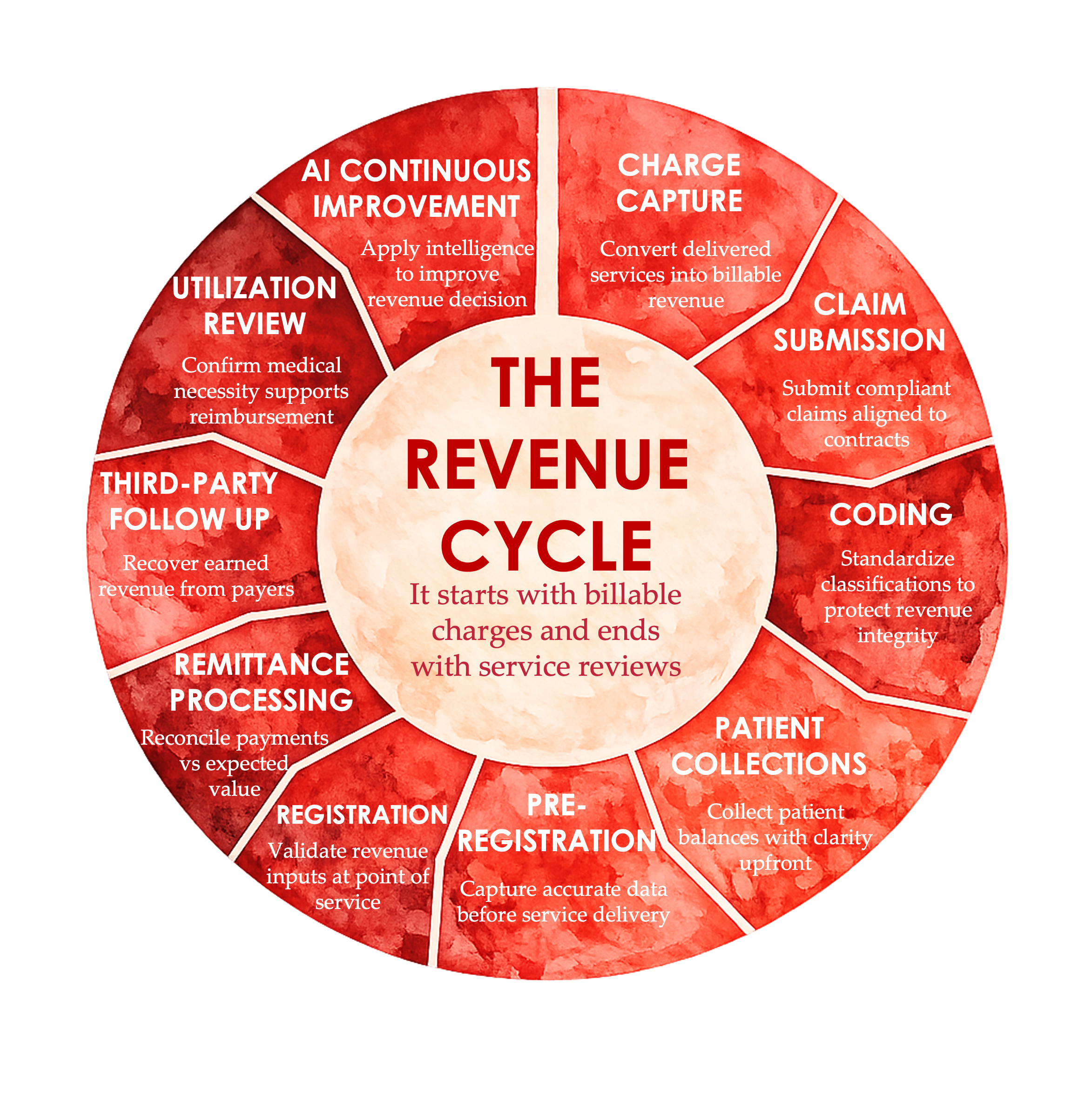
In healthcare (but not the exclusive applicable industry), this moment often triggers a closer look at Revenue Cycle Management (RCM). Leaders pull up the familiar RCM “wheel” (See below) – patient access, coding, billing, collections, reporting – and reassure themselves that each function technically exists. The wheel is intact. The problem must be execution.

That assumption is usually wrong.

The issue isn’t that the wheel is broken. It’s that the wheel is optimized locally-by function, by vendor, by department-rather than architected as a system designed to scale.

And that distinction matters far beyond healthcare.

Sam Palazzolo's The RCM Wheel Is Lying to You

Revenue Cycle Management Is a System, Not a Department

At its core, Revenue Cycle Management refers to the end-to-end process of capturing, managing, and realizing revenue-from initial customer engagement through final payment and reconciliation. In healthcare, this includes eligibility, coding, claims submission, payment posting, and collections. In SMBs more broadly, the labels change, but the mechanics don’t.

Every RCM wheel attempts to do three things:

  1. Protect revenue integrity
  2. Optimize cash velocity
  3. Create predictability for reinvestment

When any one of those breaks down, growth stalls.

Industry research consistently shows that revenue leakage-caused by process fragmentation, unclear ownership, and misaligned incentives-costs organizations 3-5% of net revenue annually (HFMA; Change Healthcare). For a $50M organization, that’s $1.5M-$2.5M evaporating every year, often invisibly.

That’s not an execution problem. That’s an architecture problem.

Why “Revenue Integrity” Is the Hidden Constraint

Most leadership teams focus on top-line growth. Fewer rigorously manage revenue integrity-the assurance that revenue earned is revenue realized, accurately, completely, and on time.

In healthcare, weak revenue integrity shows up as:

  • Inconsistent coding standards
  • Payer contract misalignment
  • Poor upstream data quality
  • High downstream rework and denials

Across SMBs, it looks like:

  • Discount creep
  • Inconsistent pricing enforcement
  • Contract terms not reflected in billing
  • Sales closing deals ops can’t efficiently fulfill

Different industries. Same root cause: growth outpacing system design.

The RCM Wheel Breaks When Scale Arrives

Here’s the uncomfortable truth:
Most RCM models are designed for operation, not scale.

As volume increases, small inefficiencies compound. Manual workarounds become institutionalized. Reporting lags reality. Leaders rely on lagging indicators instead of leading signals.

The wheel still spins-but it wobbles.

This is why organizations with strong revenue growth can simultaneously experience:

  • Rising AR days
  • Margin compression
  • Cash flow volatility
  • Leadership frustration

The wheel isn’t aligned to strategy. It’s aligned to history.

“Revenue problems rarely start in billing. They start when leadership mistakes functional coverage for system design.”
– Sam Palazzolo, Managing Director, Tip of the Spear

RCM as a Scaling Discipline, Not a Back-Office Function

High-performing organizations treat Revenue Cycle Management as a cross-functional growth system, not a downstream cleanup function.

That means:

  • Revenue integrity is owned at the executive level
  • Contract economics are operationalized, not assumed
  • Data flows forward, not backward
  • Incentives reinforce system health, not local optimization

In healthcare, this shift consistently correlates with:

  • Lower denial rates
  • Faster cash realization
  • Improved forecasting accuracy

In SMBs more broadly, it unlocks something just as valuable: decision confidence.

When leaders trust the revenue engine, they invest faster, hire earlier, and scale with intention instead of caution.

Why Stalled Growth Is Usually Structural

For $5M-$100M organizations, stalled growth is rarely about ambition or effort. It’s about structural constraints that were invisible at smaller scale.

Revenue Cycle Management is often where those constraints surface first-but not where they originate.

They originate in:

  • Strategy that outgrows operating cadence
  • Leadership bandwidth stretched too thin
  • Processes built for survival, not scale
  • Financial systems optimized for reporting, not insight

RCM is the mirror. Not the root cause.

What Leaders Need to Internalize

Let’s bring this home.

  • Revenue Cycle Management is not a wheel to maintain-it’s a system to architect.
  • Revenue integrity is the difference between growth that compounds and growth that leaks.
  • Stalled organizations don’t lack effort; they lack alignment between strategy and execution.
  • The same RCM principles that constrain healthcare systems quietly stall SMBs across industries.

If revenue feels harder than it should, the issue isn’t effort.
It’s structure.

And structure can be diagnosed.

Sam Palazzolo, Managing Director @ Tip of the Spear
Fractional CRO / CRMO · Revenue Architecture & Scale

Filed Under: Blog Tagged With: healthcare, Revenue Cycle Management Strategy, sam palazzolo, strategy

McKinsey’s AI Workforce Shift

February 16, 2026 By Tip of the Spear

Over the last decade, I’ve been brought into dozens of companies between $5M and $100M in revenue that all sound different on the surface – but break in exactly the same way underneath. The pipeline is inconsistent. Forecasts aren’t trusted. Sales, marketing, and operations don’t agree on the numbers. And investors are asking a question leadership can’t confidently answer: “How predictable is your revenue, really?”

What’s changed isn’t effort or ambition. What’s changed is the operating model. And McKinsey’s recent analysis on AI-driven workforce transformation puts hard data behind what I’ve been seeing in the field for years: revenue growth is no longer a headcount problem – it’s a productivity and leadership problem.

So is consulting dead? Maybe, but this is exactly why fractional CRO and RevOps leadership isn’t a stopgap anymore. It’s becoming the default growth model for successful companies of the future.

McKinsey’s “25 Squared” Project: Shrinking Teams and Expanding Output

One of the most telling McKinsey takeaways is this: the firm increased client-facing roles by roughly 25%, reduced non-client-facing roles by 25%, and still grew overall output.

I see the same pattern in SMBs and portfolio companies. Revenue teams were built for a world where scale required more people: more SDRs, more analysts, more RevOps admins. AI has blown that assumption apart.

Today, many of those tasks – reporting, data cleanup, pipeline hygiene, even first-pass outreach – are automated or AI-assisted. But here’s the uncomfortable truth: most companies didn’t replace those tasks with better leadership or strategy. They just layered AI on top of a broken revenue system.

Fractional RevOps works because it matches this new reality. You don’t need more bodies. You need fewer, better decisions – executed faster.

Productivity Gains Are Real – But Only If Someone Owns Them!

McKinsey reports saving 1.5 million hours annually by using AI for research, synthesis, and repetitive work. That time didn’t disappear – it was redeployed toward higher-value thinking and execution.

This is where I see companies struggle.

They invest in tools. They buy AI platforms. They expect productivity gains to magically show up in revenue. But productivity without ownership just creates faster chaos.

Fractional CROs and RevOps leaders exist to convert productivity into performance. We decide:

  • Which metrics matter
  • How pipeline should actually flow
  • What “forecastable” really means
  • Where AI accelerates execution – and where it introduces risk

Without that leadership layer, AI becomes noise. With it, AI becomes leverage.

The “25 Squared” Model Is Why Fractional Leadership Wins

McKinsey described its approach as “25 squared“: fewer support roles, more value-creating roles, and higher overall output. That’s not a consulting insight – it’s an operating principle.

Fractional revenue leadership follows the same logic.

Instead of hiring:

  • A full CRO
  • A full RevOps team
  • Multiple layers of management

Companies bring in experienced leadership exactly where it creates leverage, without long ramp times or fixed overhead. I’ve seen this reduce cost, increase clarity, and – most importantly – restore trust in the numbers.

For investors, this matters. Predictability beats growth theater every time.

AI Agents Are Replacing Tasks – Not Accountability

McKinsey now operates with roughly 40,000 human professionals and 25,000 AI agents, with near parity expected soon.

This mirrors what I see across revenue organizations. AI agents can:

  • Update CRMs
  • Generate reports
  • Draft emails
  • Analyze trends

What they cannot do is own a revenue number.

Fractional CROs sit precisely at this intersection: translating AI output into executive decisions, aligning GTM teams around shared metrics, and making tradeoffs when data conflicts. AI accelerates execution – fractional leadership ensures it moves in the right direction.

Junior Work Isn’t Disappearing – It’s Being Rewritten

Another subtle but critical McKinsey takeaway: junior roles aren’t going away – they’re changing. AI absorbs the grunt work, forcing humans to operate at a higher level sooner.

This is happening inside revenue teams right now. The old apprenticeship model – “learn by doing admin work for two years” – is collapsing. Without strong RevOps leadership, that creates confusion and burnout.

Fractional RevOps introduces structure, playbooks, and guardrails so teams can actually grow into this new reality instead of being overwhelmed by it.

Why Investors Are Driving This Shift Faster Than Founders

VCs, PE firms, and family offices don’t want heroics. They want repeatability. Traditional revenue teams are slow to adapt, expensive to fix, and difficult to unwind.

Fractional CRO and RevOps leadership gives investors:

  • Faster time-to-impact
  • Clear diagnostics across portcos
  • Consistent revenue governance
  • Predictable forecasting frameworks

That’s why I increasingly see fractional leadership deployed before full-time hiring – not after failure, but as a growth accelerant.

Revenue Leadership Has Changed – Permanently

McKinsey’s workforce data confirms what many operators already feel: output is being decoupled from headcount. AI has rewritten the rules. The companies that win aren’t the ones hiring faster – they’re the ones aligning smarter.

From my seat, fractional CRO and RevOps leadership isn’t a trend. It’s the natural response to an AI-augmented world where productivity is abundant, but clarity is scarce.

If revenue feels stalled, forecasts feel fragile, or investors are pushing for predictability – the problem isn’t effort. It’s the model.

And the model has already changed.

Sam Palazzolo, Managing Director @ Tip of the Spear

McKinsey’s AI Workforce Shift

Filed Under: Blog Tagged With: ai, artificial intelligence, Fractional RevOps leadership, sam palazzolo

Getting Clarity on AI ROI: You’re Looking at It All Wrong

December 4, 2025 By Tip of the Spear

The Point: For all the noise surrounding artificial intelligence (AI), most organizations still fail to capture meaningful return on investment (ROI). Leaders chase models, vendors, and pilots, yet the business case stays fuzzy and the outcomes underwhelm. The problem rarely lies with the technology. It lies with how organizations think about value, structure their operating models, and measure performance. AI ROI isn’t elusive. My experience: It’s simply being approached from the wrong direction!

Where AI ROI Breaks Down

94% of executives expect AI to create competitive advantage… Only 27% can point to meaningfully scaled outcomes. (Deloitte, State of AI in the Enterprise)

Across industries, the pattern is remarkably consistent. Organizations overestimate what AI can deliver in the short term, underestimate what it can deliver in the long term, and misdiagnose where value actually comes from.

A 2023 Deloitte global AI survey found that while 94 percent of executives expect AI to create competitive advantage, only 27 percent can point to meaningfully scaled outcomes (Deloitte, State of AI in the Enterprise). The gap is not conceptual; it’s operational. Most companies deploy AI as tools layered onto legacy processes rather than rethinking the processes themselves.

MIT Sloan’s research reinforces this. Companies that report the highest AI ROI invest 70 percent more in change management, workflow redesign, and capability building than their lower-performing peers (MIT Sloan Management Review, The Cultural Dividend of AI). In short: organizations expect returns from AI without transforming the environment needed to produce them.

Chasing the Wrong Metrics

Another root cause is measurement. Leaders track AI ROI as if they’re buying a server rack: cost in, efficiency out. That narrow frame kills strategic value before it ever emerges.

McKinsey’s 2024 Global AI Survey notes that top-performing AI organizations measure value across three horizons:

  1. Immediate efficiency gains
  2. Mid-term revenue acceleration
  3. Long-term business model transformation

Only 18 percent of companies track all three. Everyone else gets trapped in short-term savings, missing where the exponential value sits. AI’s highest ROI rarely comes from automating tasks. It comes from redefining how the enterprise creates value, from dynamic pricing to predictive operations to personalized product ecosystems.

BCG’s research found that companies using multi-horizon metrics are 2.5x more likely to report positive AI ROI (BCG, AI and the Future of Business Value). You can’t capture value you never measure.

You Don’t Have an AI ROI Problem. You Have an Operating Model Problem.

Technology is the easy part. Integrating it requires an operating model built for speed, experimentation, and cross-functional execution. Instead, most organizations treat AI as a feature bolted onto old habits.

Harvard Business Review’s analysis of failed AI programs points to three recurring issues (HBR, Why So Many AI Pilots Fail):

  • Fragmented ownership that leaves strategy unclear
  • Lack of data readiness, forcing teams to innovate on unstable foundations
  • Underinvestment in talent, training, and adoption

Executives want AI to behave like a neatly scoped IT project. But AI is an organizational capability, not a tool. It requires governance, decision rights, and incentives aligned with how algorithms learn and iterate. Without those, ROI will always look disappointing.

Sam Palazzolo Getting Clarity on ROI

The Organizations Getting AI ROI Right Do Five Things Differently

Across Deloitte, MIT, BCG, and McKinsey’s research, the pattern is strikingly consistent. High-return AI organizations:

1. Tie AI to fewer, higher-stakes business outcomes.

They don’t launch 30 pilots. They launch 3 that matter. They begin with revenue-critical, customer-facing, or operational choke points.

2. Invest in foundational data and infrastructure.

The companies realizing the strongest returns spend 40–60 percent of their AI investment on data readiness, not models (McKinsey). They optimize the soil before planting the seeds.

3. Rewire workflows, not just tasks.

AI ROI accelerates when companies redesign how decisions get made. Not “automate the process,” but “transform the process.”

4. Build skills and adoption into the plan from day one.

Top performers devote disproportionate energy to change management, training, and user enablement (MIT Sloan). AI only creates ROI if humans actually use it.

5. Measure value across efficiency, revenue, and transformation.

Companies that restrict AI ROI to cost savings stunt their upside. The biggest returns come when AI reshapes the business model.

If You Want AI ROI, Stop Treating AI as an Experiment

The uncomfortable truth for executives is this: AI isn’t underperforming. Your strategy is. Many organizations still treat AI as a sandbox initiative rather than a lever of enterprise value creation.

When leaders shift the conversation from “Which model should we buy?” to “Where is the bottleneck in our value chain that AI can fundamentally rewire?” everything changes. That’s when ROI stops being anecdotal and starts being systemic.

The next wave of competitive advantage won’t come from who deploys AI first. It will come from who deploys AI intelligently. Clarity on ROI requires clarity on strategy, operating model, measurement, and adoption. Get those right, and AI becomes not a cost center but a force multiplier.

Getting AI ROI isn’t hard.
Looking at it correctly is.

Sam Palazzolo, Real Strategies. Real Results.

Sources

  • Deloitte. (2023). Generating value from generative AI: Companies are already investing in AI to generate value. Deloitte Insights.
    URL: https://www2.deloitte.com/us/en/insights/industry/technology/generative-ai-value.html
  • Deloitte. (2022–2023). State of AI in the Enterprise (5th edition series). Deloitte Insights.
    URL: https://www2.deloitte.com/global/en/pages/consulting/articles/state-of-ai.html
  • McKinsey & Company. (2024, May 30). The state of AI in early 2024: Gen AI adoption spikes and starts to generate value.
    URL: https://www.mckinsey.com/capabilities/quantumblack/our-insights/the-state-of-ai-in-2024
  • McKinsey & Company. (2025, March 12). The state of AI: How organizations are rewiring to capture value.
    URL: https://www.mckinsey.com/capabilities/mckinsey-digital/our-insights/the-state-of-ai-how-organizations-are-rewiring-to-capture-value
  • Davenport, T. H., & Ronanki, R. (2018). Artificial intelligence for the real world. Harvard Business Review, 96(1), 108–116.
    URL: https://hbr.org/2018/01/artificial-intelligence-for-the-real-world
  • MIT Sloan Management Review & Boston Consulting Group. (2023). The Cultural Dividend of AI. MIT Sloan Management Review.
    URL: https://sloanreview.mit.edu/projects/the-cultural-dividend-of-ai/

Filed Under: Blog Tagged With: ai, artificial intelligence, return on investment, roi, sam palazzolo

How AI Is Rewriting SaaS Economics

October 23, 2025 By Tip of the Spear

The Point: SaaS economics has typically followed a predictable formula: acquire users, expand seat licenses, drive net dollar retention, and compound recurring revenue. That model is now under structural pressure thanks to AI. Artificial intelligence (AI) is changing how software creates value, how customers consume it, and how revenue is captured. The economic engine behind SaaS is being rewritten in real time—and legacy pricing and revenue models are already falling behind.

The SaaS industry has reached a turning point. AI is no longer a feature; it is an economic force to be reckoned with. The software companies that fail to redesign their revenue architecture around AI will see a widening gap between product cost and monetization, resulting in gross margin compression and stalled net retention. Those that act decisively now will build durable revenue advantages and long-term enterprise value.

In this article, I’m exploring how AI is altering the economic structure of SaaS—not just product roadmaps. We’ll examine why traditional seat-based pricing is breaking down, how value is migrating to workflow and outcome-based models, and what this shift means for margins, ARR predictability, and revenue expansion. More importantly, we’ll outline the new rules of SaaS monetization—how to align pricing with value, protect gross margins from AI-driven compute costs, and build a revenue architecture designed for expansion in the AI era… Enjoy!

AI Is Collapsing Legacy SaaS Unit Economics

Traditional SaaS revenue is built on a simple assumption: value is proportional to the number of users who access the product. AI breaks that logic. AI-enabled systems do not simply enable human work—they perform work. Value is shifting away from access and toward output: documents analyzed, code generated, leads qualified, transactions reconciled.

This shift has two economic consequences:

  1. Work replaces users as the value driver. In AI-powered products, usage intensity matters more than license count.
  2. Costs are no longer near-zero marginal. AI inference and compute introduce visible cost of goods sold. Gross margins tighten unless monetization evolves.

If revenue stays tied to seat-based pricing while AI workloads scale, SaaS companies face a structural squeeze: higher operating costs without corresponding revenue capture. This is already visible in earnings calls where AI “feature launches” fail to show material revenue impact.

Why Seat-Based Pricing Is No Longer Enough

The subscription model is not dead, but it is no longer sufficient on its own. Seat-based revenue assumes value is unlocked by giving humans access to a tool. But when AI is performing the work, value is created through action and autonomy—not logins.

This is why the industry is moving toward hybrid monetization models that combine a platform subscription with consumption-based AI pricing. This evolution accomplishes three key economic goals:

  • Aligns price with value — AI revenue scales with customer outcomes
  • Protects gross margin — usage pricing offsets inference cost
  • Drives expansion — usage can grow faster than seat count

This is not theory. Cloud computing went through the same transformation a decade ago—consumption-based models unlocked revenue expansion and hardened defensibility. AI is now accelerating a similar shift in SaaS.

Revenue Must Be Rebuilt Around Value-Captured Economics

Most SaaS companies are still pricing AI the wrong way—either buried as a bundled feature or sold as a premium add-on with arbitrary uplift. Both approaches disconnect revenue from the true value AI creates.

Instead, AI monetization must be tied to value meters—pricing linked directly to measurable output or workflow impact. Examples of value meters include:

  • Contracts processed (legal tech)
  • Transactions reconciled (fintech)
  • Alerts triaged (cybersecurity)
  • Campaigns generated (marketing)
  • Tasks automated (horizontal AI platforms)

The strategic question for CEOs is not whether to shift monetization—but where to meter value. At the action level? Workflow level? Business outcome level? The decision defines long-term revenue scalability.

Real Example: How One Company Rebuilt Around AI Consumption Economics

A mid-market compliance software provider faced a pricing challenge. It introduced an AI agent that could automatically review and categorize policy documents. Usage surged—but so did inference costs, eroding gross margins by 14 percent. Seat-based pricing was misaligned with AI workload volume.

The company redesigned monetization:

  • Base SaaS access: $30,000 annual platform fee
  • AI consumption: Priced per document processed, with tiered volume levels
  • Value metric: “Compliance documents analyzed autonomously”

The economic impact:

  • Net dollar retention increased from 112% to 137%
  • Gross margin stabilized above 74%
  • Expansion revenue came from AI usage—not headcount growth

The lesson: businesses that shift monetization from users to workflows will out-scale seat-locked competitors and protect margin in an AI-driven market.

AI Economics Reshape the Entire Revenue Architecture

AI monetization is not a pricing project—it is a revenue architecture redesign. It requires shifts across product, revenue operations, finance, and go-to-market.

AreaAI Economic Impact
ProductMust define value meters and usage telemetry
PricingShift to platform + usage + tiered value packaging
Revenue OperationsActivate consumption growth, not just license sales
GTM MotionComp plans must reward usage adoption and workflow expansion
Finance ModelMove beyond ARR to include Consumption Revenue, AI Gross Margin, and Usage-Based NRR
Investor NarrativeCommunicate long-term value of consumption expansion to avoid misinterpretation as revenue volatility

Leadership teams that treat AI pricing as a “feature SKU update” will fall behind. This is an operating model evolution.

Strategy Before Features—and Pricing Before Product

AI creates two types of SaaS companies: those who build AI features and hope revenue follows, and those who architect monetization first and build product around unit economics. The second group will dominate the next decade.

To lead in AI economics, CEOs should drive five immediate actions:

1. Define the AI Value Thesis

Determine where AI drives measurable economic impact—speed, accuracy, cost reduction, throughput.

2. Select the Right Value Meter

Tie pricing to value delivered per workflow, transaction, or autonomous task.

3. Introduce Hybrid Monetization

Anchor revenue in platform subscriptions while capturing AI usage expansion.

4. Protect Gross Margin

Track AI cost per workflow and enforce margin targets with tiered usage pricing.

5. Build a Usage-Based GTM Model

Shift sales comp and customer success toward consumption activation and workflow ownership.

Operator-Level Takeaways

  • AI destroys the assumption that SaaS value equals seat licenses.
  • Revenue must shift from access to output to capture value created by AI.
  • Consumption pricing is not an experiment—it’s an economic evolution.
  • Companies that wait for “pricing clarity” will be priced by competitors.
  • Investors will reward those who deliver expanding usage economics with protected margins.

AI is not just changing software—it is changing software economics. The companies that act now will define the next era of enterprise value creation.

Sam Palazzolo
Real Strategies. Real Results.

PS – Subscribe to my Business Scaling Newsletter for weekly operator frameworks and AI strategy tools that drive execution.

Sam Palazzolo's How AI Is Rewriting SaaS Economics

Filed Under: Blog Tagged With: ai, artificial intelligence, business growth, SaaS Economics, sam palazzolo, Scaling Strategy

  • « Go to Previous Page
  • Page 1
  • Page 2
  • Page 3
  • Page 4
  • Interim pages omitted …
  • Page 58
  • Go to Next Page »

Primary Sidebar

Newsletter

Related Content

  • 83% of CEOs say AI depends on people. Only 25% use it regularly.
  • Your growth plan is not a Finance exercise
  • From Budget to Enterprise Value: How Leaders Should Approach Budget Season
  • How Old Is the Number You Just Gave Your Board?
  • Your Core Process Is One Resignation Away From Breaking
  • Only 30% of Leaders Get This Right
  • Ask 5 Leaders What the Strategy Is. Count the Different Answers.

Search Form

Footer

From the Tip of the Spear

Operational intelligence for growth-stage executives. Every Tuesday at 6:15 AM ET. Subscribe today and receive the Enterprise Value Playbook immediately.
DOWNLOAD NOW

Copyright © 2012–2026 · Tip of the Spear Ventures LLC · Members Only · Terms & Conditions · Privacy Policy · Log in