• Skip to main content
  • Skip to footer

Tip of the Spear Ventures

A Family Office that behaves like Venture Capital | Private Equity | Business Consulting

  • Advisory Services
    • BRANDING & GTM
    • BUSINESS GROWTH
      • PE & VC Portfolio Growth
      • Executive Coaching for PE & VC
    • VENTURE FUNDING
      • Capital Raise & Network Access
    • M&A
  • FO Direct Investments
  • The Point Blog
  • Contact Us
  • FREE eBOOK

Blog

Without Leadership Alignment, AI Performance Stalls

July 22, 2026 By Tip of the Spear

Why leadership alignment, not technology, is the true driver of AI success.

According to Deloitte’s AI ROI: The Paradox of Rising Investment and Elusive Returns, 85% of organizations increased their AI investment over the past year, and 91% expect to increase spending again. Yet only 6% report realizing satisfactory returns within the first year. Most organizations require two to four years to achieve meaningful ROI, far longer than the seven to twelve months typically expect from major technology investments.

This growing disconnect raises an important question for executive teams and boards alike: if organizations are investing more than ever in artificial intelligence, why are so few realizing meaningful business value?

In my experience, the answer has remarkably little to do with the technology itself. Organizations rarely fail because they selected the wrong large language model, purchased the wrong platform, or lacked technical capability. They struggle because their executive teams never established a shared definition of what AI was expected to accomplish. Without alignment at the top, even the most sophisticated AI initiatives become fragmented, difficult to govern, and nearly impossible to measure. Technology can accelerate transformation, but only leadership alignment determines whether transformation actually occurs.

Leadership Alignment Determines Whether Transformation Actually Occurs

The organizations creating sustainable competitive advantage with AI are not necessarily those making the largest investments. They are the ones aligning strategy, governance, operations, finance, technology, and talent around a common vision of enterprise value before implementation begins.

Across my work advising executive leadership teams, three patterns consistently emerge.

Pattern 1: AI Has No Single Organizational Owner

Artificial intelligence touches every function of the enterprise, yet responsibility for its success typically resides nowhere in particular. Each member of the executive team approaches AI through the lens of individual functional responsibility. The CEO views AI as a catalyst for enterprise growth and competitive positioning. The CIO evaluates platforms, infrastructure, cybersecurity, and technology integration. The COO focuses on operational efficiency and process improvement. The CFO seeks measurable return on investment and disciplined capital allocation. Human Resources evaluates workforce readiness, organizational change, and evolving talent requirements. Legal and Compliance concentrate on governance, privacy, and risk.

Each of these perspectives is rational and necessary in isolation, but collectively insufficient unless integrated into a common enterprise strategy. This is the point at which most organizations lose enterprise coherence without recognizing it. Marketing implements generative AI for content creation. Customer service deploys intelligent chatbots. Finance automates reporting. Operations introduces predictive analytics. Human Resources experiments with AI enabled recruiting and learning platforms. Each initiative delivers incremental value, but few create enterprise value, because the organization has mistaken functional optimization for enterprise transformation.

Rather than building an integrated AI strategy, organizations unintentionally assemble a portfolio of disconnected initiatives. Individual functions optimize locally while the enterprise fails to optimize collectively. The consequence is predictable: different business units establish different priorities, success is measured inconsistently, investments compete rather than reinforce one another, governance becomes fragmented, and accountability becomes unclear. The organization does not lack AI capability. It lacks enterprise leadership.

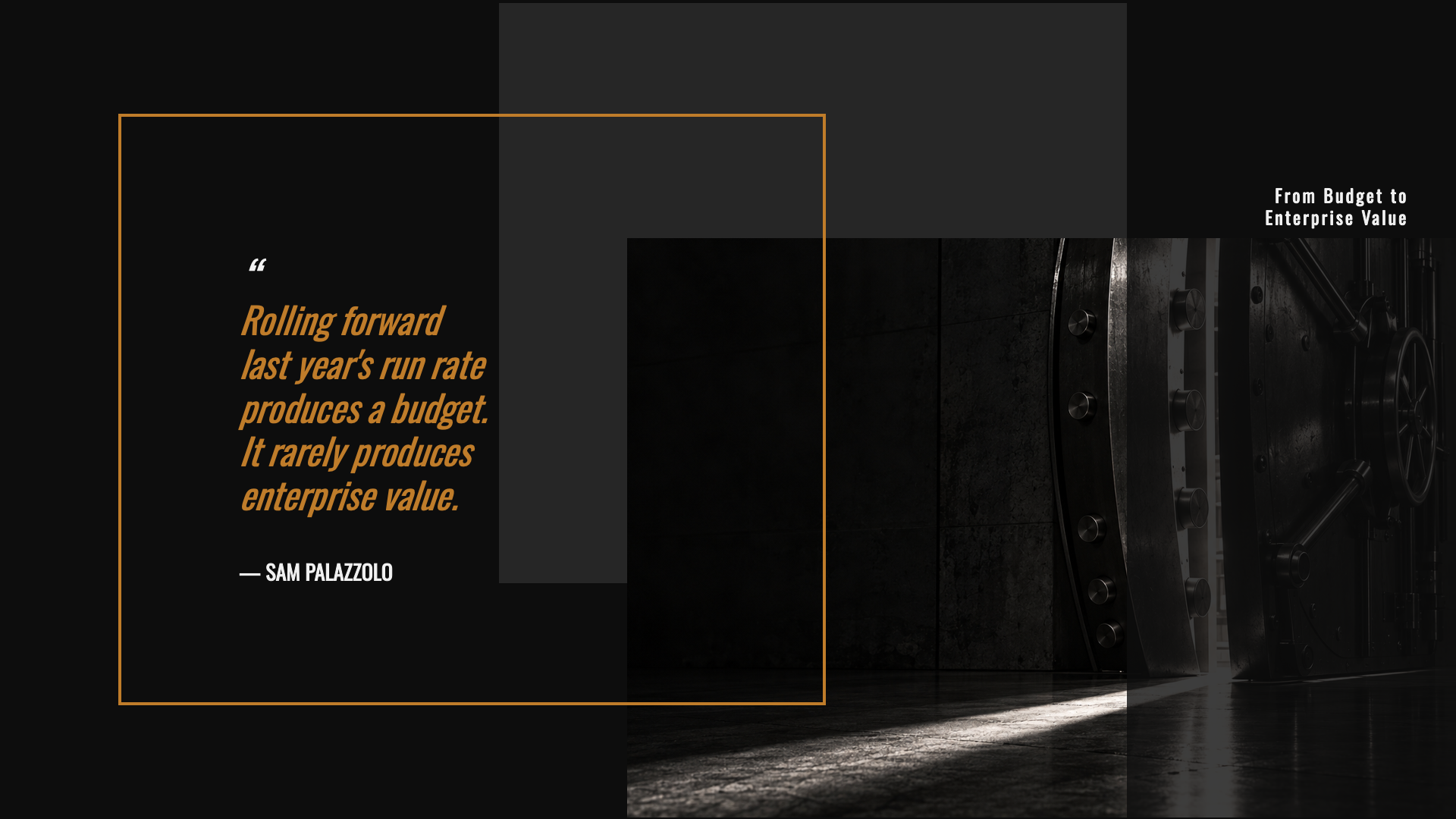
“AI does not fail because organizations lack technology. It fails because leadership lacks alignment on what success actually looks like.”

Sam Palazzolo

Pattern 2: Leaders Agree on AI’s Potential but Define Success Differently

Few executive teams question whether artificial intelligence will reshape their industry. The disagreement begins when leaders attempt to define what success actually looks like. For one executive, success means reducing operating costs. For another, it means accelerating innovation. Sales leadership prioritizes revenue growth and customer engagement. Finance emphasizes productivity improvements and margin expansion. Operations focuses on cycle times and efficiency. Human Resources measures adoption, capability development, and employee effectiveness. Each objective is legitimate on its own terms, but none is comprehensive.

When every executive measures AI through a different scorecard, organizational alignment deteriorates long before implementation begins. Resources become fragmented, priorities shift, teams receive inconsistent direction, and performance metrics become increasingly difficult to reconcile. The organization remains committed to AI investment; it simply lacks a common operating definition of success.

The most successful AI transformations begin long before selecting vendors, deploying copilots, or launching pilots. They begin with executive agreement on the business outcomes AI is expected to deliver and the enterprise metrics that will define success. Only then does technology become an accelerator rather than a distraction.

“Every executive has a valid perspective on AI. The competitive advantage comes when those perspectives become one enterprise strategy.”

Sam Palazzolo

Pattern 3: AI Investment Is Accelerating Faster Than Organizational Readiness

The pace of AI investment continues to accelerate. Enterprise software providers are embedding AI into nearly every application. Organizations are expanding licenses, funding pilots, and launching new use cases at unprecedented speed. Boards increasingly expect management teams to articulate credible AI strategies capable of improving both competitiveness and enterprise performance.

Leadership readiness has not advanced at the same pace. Many organizations have invested heavily in AI technologies while investing comparatively little in governance, executive accountability, operating models, workforce enablement, or change management. Technology adoption has outpaced organizational maturity, and this imbalance creates an increasingly familiar pattern: executives expect transformational outcomes from organizations that have not yet established the leadership disciplines necessary to sustain transformation.

Technology scales rapidly. Alignment does not. Alignment requires deliberate communication, shared accountability, executive sponsorship, clear governance, and consistent decision-making. Organizations that overlook these fundamentals frequently mistake implementation for transformation, and the two are fundamentally different. Implementation introduces technology. Transformation changes how the enterprise creates value.

“Technology scales in months. Leadership alignment often takes years. The organizations that close that gap first will define the next decade.”

Sam Palazzolo

Executive Imperative: Leadership Alignment Is the Competitive Advantage

Artificial intelligence is no longer simply a technology initiative. It is an enterprise leadership challenge. Organizations that create lasting competitive advantage through AI will not necessarily be those with the largest technology budgets, the most sophisticated models, or the greatest number of pilots. They will be the organizations whose executive teams align strategy, governance, operations, finance, technology, and talent around a common vision of enterprise value.

Leadership alignment transforms AI from a collection of disconnected initiatives into an integrated business capability. It establishes ownership, creates accountability, aligns investment priorities, and enables consistent decision-making. Most importantly, it provides the organizational discipline required to convert technological capability into measurable business performance.

Artificial intelligence is rapidly becoming a strategic differentiator. Leadership alignment will determine which organizations capitalize on that opportunity and which continue searching for returns that remain just out of reach.

“Artificial intelligence is no longer a technology initiative. It is the executive operating model that will separate tomorrow’s market leaders from everyone else.”

Sam Palazzolo

The question facing executive teams is no longer whether to invest in artificial intelligence. Most already have. The more consequential question is whether the leadership team shares a common understanding of why those investments are being made, how success will be measured, and who will ultimately be accountable for delivering enterprise value. Until those questions are answered collectively, AI performance will continue to fall short of its potential. Technology can accelerate execution, but only aligned leadership can accelerate enterprise transformation.

Questions Every Executive Team Should Be Asking

As artificial intelligence becomes embedded across every function of the enterprise, executive teams should routinely ask themselves five questions:

  1. Do we have a shared definition of AI success across the executive team?
  2. Who owns enterprise AI outcomes beyond individual functional initiatives?
  3. Are we measuring business value or simply tracking technology adoption?
  4. Does our governance model enable responsible, scalable, enterprise-wide decision-making?
  5. Are we scaling AI capabilities faster than we are developing leadership alignment and organizational readiness?

Organizations that can answer these questions with confidence are far more likely to translate AI investment into sustainable competitive advantage. Those that cannot may discover that their greatest obstacle is not the technology they purchased. It is the leadership alignment they never established.

Sam Palazzolo
Operator. Investor. Educator. Enterprise Value Strategist.
Scaling organizations. Maximizing enterprise value.

Sam Palazzolo - Without Leadership Alignment, AI Performance Stalls

Filed Under: Blog Tagged With: AI ROI, AI Transformation, Enterprise AI Strategy, Executive Leadership, leadership alignment, sam palazzolo

The Buyer Is Not Asking For Less Work. They Are Asking For a Lower Price.

July 21, 2026 By Tip of the Spear

ISSUE XVI

FROM THE TIP OF THE SPEAR

SAM PALAZZOLO

WELCOME TO ISSUE #16

​McKinsey research on pricing found that more than half of companies surveyed, 57 percent, say their sales teams lack adequate negotiation training to communicate and support price changes, and 42 percent report no deal-level pricing guidance exists at all.

That is not a training gap. It is an exposure. A seller with no pricing guidance has nothing to hold onto when a buyer starts trimming the deal, and the buyer knows it before the seller does.

The buyer does not walk in and ask for a lower price. That request is too easy to refuse. Instead, the buyer walks in and asks for less work, and waits for the price to follow it down. This week’s Price Pressure Play is The Scope Minimizer. The Margin Protection Move that breaks it is The Scope Trade.

GIVING AWAY SCOPE TO PROTECT A DEAL THAT WAS NEVER AT RISK?

Most growth diagnostics measure win rate. I measure what the win actually cost. If you run or advise a VC, PE, or family office backed portfolio company and your team is trading scope for signatures without tracking the ratio, let’s find it before your next board meeting does.

Book 30 minutes: sp@tipofthespearventures.com​

THE PRINCIPLE

First, the play you are up against.

Price Pressure Play #16: The Scope Minimizer. The conversation has already covered full value. The buyer has agreed, in words if not in writing, that the complete offering is what they need. Then comes the pivot: “We’ve been thinking, we probably don’t need all of that. Can we strip the scope down?” The sentence sounds like a planning correction. It is a price correction wearing a scope costume. Watch for a reduction request that arrives only after commercial terms are on the table, a proposed cut that does not proportionally reduce your delivery cost, and a buyer who keeps circling back to the total number rather than the adjusted work.

The Play they are Running

The mechanism is Commitment and Consistency, and the buyer is using it against you in reverse. Earlier in the deal, you both agreed to their goal. Now they invoke that same agreement to justify taking scope away, framing it as helping you win the business rather than helping themselves pay less for it. The tell is proportionality. If the scope drops 20 percent but the requested discount runs 35 percent, the buyer is not managing their budget. They are managing yours.

Your Counter

Margin Protection Move #16: The Scope Trade. Scope is currency. It does not get given away for free, and it does not get reduced without an equivalent reduction in investment. The ratio holds every time, without exception.

Step one. “I can absolutely work with you on the investment structure. Here is how I think about it.”

Step two. “If we remove [specific deliverable], the investment adjusts to $[reduced price]. If we remove [deliverables A and B], it comes to $[further reduced]. Each adjustment is proportional. I want to make sure we are being precise about the tradeoff. Which structure delivers what you need at an investment level that works?”

Come to the conversation with scope tiers and their corresponding investment levels already built. Never reduce price without naming exactly what scope leaves with it.

The Cialdini Principle at Work

Reciprocity. You give scope reduction. They give investment proportionality. The exchange is transparent and fair on its face, which makes it difficult to argue against without the buyer explicitly asking for less scope at the same price, a request most buyers will not make out loud.

The Win Condition

The buyer selects a scope tier at its corresponding investment level, and your margin ratio holds. Or the buyer decides they need the full scope after all, and the Scope Minimizer is neutralized entirely.

WHAT WEAK SELLERS DO INSTEAD

They agree to the smaller scope to close the deal, then recalculate their delivery cost afterward and discover they are doing nearly the same work for meaningfully less revenue. I help portfolio companies build the scope tiering into the proposal stage, before the buyer ever gets to ask.

Email me to talk through what that looks like for your team: sp@tipofthespearventures.com​

MARKET INTELLIGENCE

Three signals from this week across Venture Capital, Private Equity, Family Offices, and Capital:

  1. KKR agreed to acquire a 51 percent stake in Thomson Reuters’ Global Print business for roughly $500 million, forming a joint venture in which Thomson Reuters retains a minority equity interest and receives structured financial support designed to guarantee KKR a minimum return. A sponsor taking control of a legacy print asset while the parent keeps optionality on the AI-facing core business. Source: The Globe and Mail​
  2. S&P Global Market Intelligence reported that global private equity and venture capital firms announced 1,504 exits in the first half of 2026, down 6 percent from the 1,601 exits recorded in the first half of 2025, with the aggregate value skewed almost entirely by a single mega-deal. The exit backlog is not clearing, it is concentrating. Source: S&P Global Market Intelligence​
  3. Balbec Capital closed more than $930 million in commitments for its newest asset-based credit fund, a vehicle focused on commercial and residential mortgage debt across the US and western Europe, including performing and non-performing loans and mortgage servicing rights. Capital is still moving into private credit, it is simply moving toward harder collateral. Source: Bloomberg​

THE SAME DISCIPLINE I TEACH AT NYU IS THE DISCIPLINE BEHIND THE SCOPE TRADE.

I teach “Scaling and Exiting the Business for Maximum Value” at NYU’s School of Professional Studies. The course covers the same operator discipline behind this newsletter: recognizing when a request that looks small is actually a lever, and holding the ratio instead of the relationship hostage to it.

If you know a founder, operator, or student who would benefit from this, forward this issue or email.

Reach me directly: sp@tipofthespearventures.com​

FROM THE TIP OF THE SPEAR

A scope reduction request is not a planning conversation. It is a price conversation that has learned to dress differently.

Weak sellers respond to the costume instead of the request. They pull deliverables, hold price, and tell themselves they preserved the relationship. What they preserved was a precedent. The next buyer who hears about this deal will ask for the same thing, because it worked.

The Scope Trade is not a harder conversation than the one weak sellers are already having. It is a clearer one. Scope drops, investment drops with it, in a ratio you set before the buyer ever asked. That is not confrontation. That is precision, and precision is the only thing a buyer cannot negotiate against.

SAM SPEAKS

I speak to executive audiences on three Growth Strategy topics:

  1. Scaling and Exiting the Business for Maximum Value. Most operators spend years building a company and weeks preparing for the exit. The ones who capture maximum value at the table are the ones who treated the exit as a strategy, not an event. This talk draws on 12+ years of scaling and exiting experience across 15+ organizations, and the curriculum I am currently developing as an NYU faculty member, to give executive audiences a field-level framework for building toward a transaction from day one.
  2. The Unrealistic Leader. The leaders who build enduring organizations are not the ones who set realistic expectations. They are the ones who hold an unrealistic standard long enough for the organization to grow into it. This talk is a practitioner’s case for why the most dangerous thing a leader can do is become reasonable too early, and what it actually looks like to lead from the front when the numbers do not yet support the vision.
  3. The Price Pressure Playbook. Buyers have a playbook. Most sellers do not know it exists. Drawing from my published work cataloguing 20 buyer pressure tactics and the 20 operator moves that counter them, this talk gives revenue leaders and executive teams a tactical framework for protecting margin, closing at full value, and recognizing the moves being run against them in real time.

To inquire about speaking engagements, reach me directly: speaking@tipofthespearventures.com​

UNTIL NEXT TUESDAY

From the Tip of the Spear is my weekly publication for executives who are building something real. One issue, every Tuesday. A field report from active operator engagements, one principle with supporting data, and market intelligence from across my VC, PE, and family office network.

Sam Palazzolo, Tip of the Spear Ventures sp@tipofthespearventures.com +1 702.970.8847

Operator. Investor. Educator. Enterprise Value Strategist.​
Scaling organizations. Maximizing enterprise value.

Built with Kit​

Filed Under: Blog

The Deal Is Done. The Next Ask Is a New Deal.

July 14, 2026 By Tip of the Spear

ISSUE XV

FROM THE TIP OF THE SPEAR

SAM PALAZZOLO

WELCOME TO ISSUE #15

PMI’s Pulse of the Profession found that 52 percent of projects experience scope creep, up from 43 percent five years earlier.

More than half. Not from bad planning. From a request that arrived after the agreement was already signed, phrased small enough that saying no felt like the disproportionate move.

That is not an accident. That is a tactic, and it has a name. This week’s Price Pressure Play is The Nibble. The Margin Protection Move that breaks it is The Change Order.

IS SCOPE QUIETLY LEAKING OUT OF YOUR DEALS AFTER THE INK DRIES?

Most growth diagnostics stop measuring the moment the contract is signed. I measure what happens after, because that is where margin actually leaks. If you run or advise a VC, PE, or family office backed portfolio company and your team is absorbing “one more thing” requests without a change order in sight, the diagnostic finds it.

Book the 30 minutes: sp@tipofthespearventures.com​

THE PRINCIPLE

First, the play you are up against.

Price Pressure Play #18: The Nibble. The deal is agreed. Handshakes have occurred, sometimes in writing. Then: “One more thing, can you throw in X?” The ask is positioned as small, reasonable, and easy. It is none of those things. It is deployed precisely because you are least likely to say no when the deal is done. Watch for additional requests that arrive after verbal or written agreement, asks framed as inconsequential additions, and a pattern of small incremental asks that cumulatively represent significant value.

The Play they are Running

The mechanism is Commitment and Consistency. You have said yes to the big thing. Saying no to the small thing feels petty, relationship damaging, and disproportionate. The buyer engineered this dynamic deliberately, counting on the fact that you will not jeopardize a closed deal over something that sounds minor. The something small is never actually small. Unmanaged nibbling adds an average of 4 to 7 percent of uncompensated scope per deal, appearing negligible in isolation and compounding to significant unrecovered cost across a client relationship.

Your Counter

Margin Protection Move #18: The Change Order. The deal is done. The next ask is a new commercial conversation. Treat it exactly that way, from the first moment, with calm professionalism, and without apology. Normalizing the change order process is the entire job.

Step one. “I want to make sure we both feel good about how we move forward, and I want to be straightforward with you about this.”

Step two. “What you are describing is outside the agreed scope. I would like to put together a quick change order that outlines the additional work and the corresponding investment, then we can decide together whether to include it in this phase or address it in the next one. That way everything is documented and there are no surprises for either of us.”

Do not apologize. Do not say “normally I would.” Treat the change order as standard process, because it should be.

The Cialdini Principle at Work

Commitment and Consistency, working in your favor this time. You are consistent with the original agreement. The buyer made a commitment to the defined scope. Anything outside that scope is a new commitment, which requires a new commercial agreement. Consistency protects both parties, not just the one asking.

The Win Condition

The additional work is scoped, priced, and documented. The buyer either approves the change order or withdraws the request. In either case, the original deal is protected and the boundary is established.

YOUR JULY PIPELINE IS FULL OF DEALS THAT LOOK CLOSED AND ARE NOT.

Every unpriced “one more thing” sitting in your active deals right now is margin that already left the building. Most revenue teams do not have a change order muscle. They have a culture of quiet yeses.

I work with portfolio companies as a Growth Architect to build the change order discipline into the sales process itself, so scope creep gets priced instead of absorbed.

Email me to talk through what that looks like for your team: sp@tipofthespearventures.com​

MARKET INTELLIGENCE

Three signals from this week across Venture Capital, Private Equity, Family Offices, and Capital:

  1. Abu Dhabi’s MGX closed its debut AI fund at $49 billion, above its reported target, one of the largest AI focused fundraises on record and a signal that sovereign capital now sets the pace for frontier infrastructure bets. Source: CNBC.com​
  2. Blackstone filed sandwich chain Jersey Mike’s for an IPO, using stronger public markets as the release valve to return cash to limited partners after a prolonged exit drought across the private equity industry. Source: Yahoo Finance​
  3. EasyJet agreed in principle to a sweetened takeover proposal from Castlelake valuing the UK budget airline at up to $7.3 billion, another sponsor betting on take private structures while traditional IPO windows stay narrow. Source: Reuters​

THE SAME DISCIPLINE I TEACH AT NYU IS THE DISCIPLINE BEHIND THE CHANGE ORDER.

This fall I am teaching “Scaling and Exiting the Business for Maximum Value” at NYU’s School of Professional Studies. The course covers the same operator discipline behind this newsletter: recognizing the pressure tactic in the room and protecting the boundary when the easy move is to give the scope away for free.

If you know a founder, operator, or student who would benefit from this, forward this issue or email.

Reach me directly: sp@tipofthespearventures.com​

FROM THE TIP OF THE SPEAR

A nibble is not a request. It is a test of whether your agreement means anything after the signature dries.

Weak sellers pass that test by failing it. They throw in the extra slide, the extra integration, the extra week of support, and they call it relationship management. It is not relationship management. It is an uncompensated precedent, and the next nibble will be bigger because the last one worked.

The Change Order is not confrontation. It is the most respectful thing you can offer a buyer: clarity about what was agreed, and an honest price for what was not. Scope that is priced gets valued. Scope that is free gets requested again.

SAM SPEAKS

I speak to executive audiences on three Growth Strategy topics:

  1. Scaling and Exiting the Business for Maximum Value. Most operators spend years building a company and weeks preparing for the exit. The ones who capture maximum value at the table are the ones who treated the exit as a strategy, not an event. This talk draws on 12+ years of scaling and exiting experience across 15+ organizations, and the curriculum I am currently developing as an NYU faculty member, to give executive audiences a field-level framework for building toward a transaction from day one.
  2. The Unrealistic Leader. The leaders who build enduring organizations are not the ones who set realistic expectations. They are the ones who hold an unrealistic standard long enough for the organization to grow into it. This talk is a practitioner’s case for why the most dangerous thing a leader can do is become reasonable too early, and what it actually looks like to lead from the front when the numbers do not yet support the vision.
  3. The Price Pressure Playbook. Buyers have a playbook. Most sellers do not know it exists. Drawing from my published work cataloguing 20 buyer pressure tactics and the 20 operator moves that counter them, this talk gives revenue leaders and executive teams a tactical framework for protecting margin, closing at full value, and recognizing the moves being run against them in real time.

To inquire about speaking engagements, reach me directly: speaking@tipofthespearventures.com​

UNTIL NEXT TUESDAY

From the Tip of the Spear is my weekly publication for executives who are building something real. One issue, every Tuesday. A field report from active operator engagements, one principle with supporting data, and market intelligence from across my VC, PE, and family office network.

Sam Palazzolo, Tip of the Spear Ventures sp@tipofthespearventures.com +1 702.970.8847

Operator. Investor. Educator. Enterprise Value Strategist.​
Scaling organizations. Maximizing enterprise value.

Built with Kit​

Filed Under: Blog

The Silence Drop Is Costing Sellers a 10 Percent Discount They Never Had to Give

July 7, 2026 By Tip of the Spear

ISSUE XIV

FROM THE TIP OF THE SPEAR

SAM PALAZZOLO

WELCOME TO ISSUE #14

​Gartner research on buyers found that forty-five percent go silent because the salesperson or vendor did not understand their business needs.

Almost half of the silence you are sitting with right now started before you ever sent the proposal. It started in discovery. The buyer stopped talking because you stopped listening, and now the quiet feels like rejection.

Here is the problem with that read. Most operators treat post-proposal silence as a verdict. It is not a verdict. It is a test, and the test has a name. This week’s Price Pressure Play is The Silence Drop. The Margin Protection Move that breaks it is The Silence Hold.

IS YOUR TEAM NEGOTIATING AGAINST ITSELF WHEN THE BUYER GOES QUIET?

Most growth diagnostics measure activity. I measure what happens in the seven days after a proposal goes silent, because that is where margin actually leaks. If you run or advise a VC, PE, or family office backed portfolio company and your reps are the ones filling the silence with concessions, the diagnostic finds it.

Book the 30 minutes: sp@tipofthespearventures.com​

THE PRINCIPLE

First, the play you are up against.

Price Pressure Play #19: The Silence Drop. You submit a proposal. No response. A week passes. You follow up. “We are still evaluating.” Then more silence. The buyer has not rejected you. They have not engaged. They are simply not responding, and your anxiety is doing their negotiating for them. Watch for silence that arrives immediately after a price is stated, follow-up responses that neither advance nor close the conversation, and a proposal that has not been rejected but has not moved forward.

The Play they are Running

The mechanism is Scarcity. Silence creates the perception that the deal is disappearing, that the buyer’s interest is a fading resource. This perceived scarcity triggers urgency in the seller, who responds by conceding to re-establish contact. Sellers who follow up post-silence with a price reduction, the single most common response, do so at an average of 10 percent below proposal price, without any buyer request. The buyer achieved a discount through inaction alone.

Your Counter

Margin Protection Move #19: The Silence Hold. Their silence is a weapon. The first person to speak loses. You will not speak first. You will set a follow-up date, hold to it exactly, and say nothing until then, and when you do speak, you will say exactly one thing.

Step one. After submitting your proposal, state the plan out loud: “I will follow up on [specific date, 7 to 10 days out] to discuss next steps.” Then stop. Send nothing else until that date.

Step two. On the follow-up date, send exactly one message: “Following up as planned. Ready to discuss next steps when you are.” Nothing else. No explanation. No discount offer. No filler. If they respond with “still evaluating,” acknowledge it and set a new specific date. Hold that date too. Every impulse to follow up with something helpful is the Silence Drop working on you. Match their silence. Your discipline is your signal.

The Cialdini Principle at Work

Scarcity, turned back on the buyer. Your silence implies that you have other options, that your pipeline does not depend on this deal. That perceived optionality makes you scarce, which makes the buyer’s engagement more valuable to them.

The Win Condition

The buyer re-engages on your timeline instead of theirs, often without a discount request, because your silence communicated that the price was not going to change regardless of how long they waited.

YOUR JANUARY SKO IS SIX MONTHS OLD. SO IS THE PLAYBOOK YOU LEFT THE ROOM WITH.

You set the targets way back in January. The market did not agree to honor them. Half the year is gone, the pipeline looks different than it did at kickoff, and the team is running January’s plays against July’s reality.

Most companies wait for Q4 to admit the gap. By then the only options left are panic and discount. A mid-year SKO is not a recap meeting. It is the one chance you get to recalibrate the team before the numbers force you to.

I work with portfolio companies as a fractional CRO and Growth Architect to run that recalibration, sharpen the second-half plays, and rebuild the urgency the room had in January.

Email me to talk through what that looks like for your team: CXO@tipofthespearventures.com​

MARKET INTELLIGENCE

Three signals from this week across Venture Capital, Private Equity, Family Offices, and Capital:

  1. Two companies just absorbed nearly half of all global venture funding. Global venture funding reached a record 510 billion dollars in the first half of 2026, and OpenAI and Anthropic alone accounted for 217 billion dollars of it, or 43 percent of all startup funding in H1. Source: Crunchbase News​
  2. Private equity’s exit math is getting worse, not better, despite a booming market elsewhere. PE firms are sitting on 13,325 unsold US companies as of the end of May, up from 12,900 last October, and it would take 11 years to sell that inventory at the current pace. Source: Yahoo Finance / PitchBook​
  3. Political scrutiny of private equity is turning into actual legislation. Several Democratic lawmakers introduced the Let’s Play Act to ban PE firms from investing in youth sports, following a private equity firm owned by former NFL quarterback Eli Manning announcing a plan to acquire youth-league operator RCX. Source: CEPR​

THE SAME DISCIPLINE I TEACH AT NYU IS THE DISCIPLINE BEHIND THE SILENCE HOLD.

This fall I am teaching “Scaling and Exiting the Business for Maximum Value” at NYU’s School of Professional Studies. The course covers the same operator discipline behind this newsletter: recognizing the pressure tactic in the room and holding your position when the easy move is to cave.

If you know a founder, operator, or student who would benefit from this, forward this issue or email.

Reach me directly: sp@tipofthespearventures.com​

FROM THE TIP OF THE SPEAR

Silence is not empty. It is full of whatever the seller brings to it. A disciplined operator fills it with a date and a plan. An anxious one fills it with a discount nobody asked for.

The Silence Drop only works on sellers who mistake quiet for information. It is not information. It is a mirror. The buyer went silent, and now you get to decide what that silence means, because they have not told you, and until they do, the price has not moved. Hold the date. Send the one message. Let the buyer’s discomfort do the work that your discount used to do for free.

SAM SPEAKS

I speak to executive audiences on three RevOps topics:

  1. Scaling and Exiting the Business for Maximum Value. Most operators spend years building a company and weeks preparing for the exit. The ones who capture maximum value at the table are the ones who treated the exit as a strategy, not an event. This talk draws on 12+ years of scaling and exiting experience across 15+ organizations, and the curriculum I am currently developing as an NYU faculty member, to give executive audiences a field-level framework for building toward a transaction from day one.
  2. The Unrealistic Leader. The leaders who build enduring organizations are not the ones who set realistic expectations. They are the ones who hold an unrealistic standard long enough for the organization to grow into it. This talk is a practitioner’s case for why the most dangerous thing a leader can do is become reasonable too early, and what it actually looks like to lead from the front when the numbers do not yet support the vision.
  3. The Price Pressure Playbook. Buyers have a playbook. Most sellers do not know it exists. Drawing from my published work cataloguing 20 buyer pressure tactics and the 20 operator moves that counter them, this talk gives revenue leaders and executive teams a tactical framework for protecting margin, closing at full value, and recognizing the moves being run against them in real time.

To inquire about speaking engagements, reach me directly: speaking@tipofthespearventures.com​

UNTIL NEXT TUESDAY

From the Tip of the Spear is my weekly publication for executives who are building something real. One issue, every Tuesday. A field report from active operator engagements, one principle with supporting data, and market intelligence from across my VC, PE, and family office network.

Sam Palazzolo, Tip of the Spear Ventures sp@tipofthespearventures.com +1 702.970.8847

12+ years ago I led a Tech (SaaS) startup to PE exit. Since, I have scaled 15+ organizations from $5M to $500M (2x $1B+).

Built with Kit​

Filed Under: Blog

Your fifth approver is not a stakeholder. It is a tactic.

June 30, 2026 By Tip of the Spear

ISSUE XIII

FROM THE TIP OF THE SPEAR

SAM PALAZZOLO

WELCOME TO ISSUE #13

​Gartner surveyed 632 B2B buyers in 2024 and found that 74% of buying teams experience unhealthy conflict during the decision process, while buying groups that reach consensus are 2.5 times more likely to report a high-quality deal outcome.

Read that again. Conflict inside the buying committee is the norm, not the exception. Most operators read that statistic as a buyer problem. It is not. It is a seller opportunity, and most sellers waste it.

Here is how. A deal you thought was closed produces a new approver. Then another. Each one arrives with fresh concerns and an implicit request for one more concession. You re-pitch, you soften the number, you wait. The unhealthy conflict Gartner measured is happening on the buyer side of the table. The unhealthy concessions are happening on yours. This week’s Price Pressure Play names the pattern (The Escalating Approver). The Margin Protection Move breaks it (The Economic Buyer Bridge).

IS PRICING PRESSURE ACTUALLY A STAKEHOLDER ACCESS PROBLEM IN DISGUISE?

Most growth diagnostics look at funnel metrics and call it a day. I look at where deals stall, who is in the room when price gets discussed, and whether your team is negotiating with the person who can actually say yes. If you run or advise a VC, PE, or family office backed portfolio company and margin compression has become routine, the diagnostic finds the source.

Book the 30 minutes: sp@tipofthespearventures.com​

THE PRINCIPLE

First, the play you are up against.

Price Pressure Play #5: The Escalating Approver. Agreement appears within reach. Then a new stakeholder materializes at a higher level than the last. First your champion. Then their VP. Then the CFO. Each new approver arrives with fresh concerns and an implicit request for additional concessions. Watch for approvals that escalate after verbal agreement, stakeholders never mentioned in discovery, and the phrase “I just need to run this by one more person.”

The Play they are Running

The mechanism is Commitment and Consistency. Each interaction builds your commitment to the deal, and that commitment gets leveraged to extract one more accommodation. You do not want to lose what you have built, so you give. The cost is not abstract. Deals that go through multi-stakeholder escalation close at an average of 21 percent below initial proposal pricing, with concessions extracted across multiple re-engagement rounds. The effect is invisible until the final number is on paper.

Your Counter

Margin Protection Move #5: The Economic Buyer Bridge. If you cannot get to the economic buyer, the deal is already lost. You just do not know it yet. Every incremental concession to a non-decision-maker is a gift with no recipient. The fix is not patience. It is access.

Step one, name the gap directly. Tell your contact that given the scope and investment under discussion, the conversation needs the economic buyer in the room before structure gets finalized. Step two, request the meeting and frame it as protecting your champion, not bypassing them. You want to help position the value case correctly for the person who will ultimately approve it, and you want to prepare your champion for that conversation, not spring it on them.

The Cialdini Principle at Work

Authority. This works because the Escalating Approver pattern depends on the seller never reaching the real decision-maker. Once that person is in the room, they evaluate value. The people below them review price. Asking for the right level of conversation signals Authority. You recognize the difference between a gatekeeper and a decision-maker, and you are experienced enough to require the latter.

The Win Condition

Either you gain access and reset the negotiation on your terms, or the buyer’s reluctance to arrange that meeting tells you something true about the deal that you can now address directly. Either outcome beats another round of concessions to someone who cannot say yes.

YOUR JANUARY SKO IS SIX MONTHS OLD. SO IS THE PLAYBOOK YOU LEFT THE ROOM WITH.

You set the targets in January. The market did not agree to honor them. Half the year is gone, the pipeline looks different than it did at kickoff, and the team is running January’s plays against July’s reality.

Most companies wait for Q4 to admit the gap. By then the only options left are panic and discount. A mid-year SKO is not a recap meeting. It is the one chance you get to recalibrate the team before the numbers force you to.

I work with portfolio companies as a fractional CRO and Growth Architect to run that recalibration, sharpen the second-half plays, and rebuild the urgency the room had in January.

Email me to talk through what that looks like for your team: CXO@tipofthespearventures.com​

MARKET INTELLIGENCE

Three signals from this week across Venture Capital, Private Equity, Family Offices, and Capital:

  1. Buying committees have nearly doubled in a decade. B2B buying committees have grown from 5.4 stakeholders in 2015 to 8 to 13 in 2025, with Gartner data cited as one of the sources behind the trend. Source: Attainment Labs​
  2. The buying group, not the vendor, is now the primary obstacle. Forrester’s 2025 research found the average B2B purchase involves 13 stakeholders, with nearly 89% of buying decisions crossing multiple departments, and separately that 86% of B2B purchases stall at some point in the process, often because one stakeholder’s concerns weren’t addressed early. Source: Traction Complete​
  3. Sellers get almost no time with the very committee deciding their fate. Gartner research shows buyers now spend only 17% of their total purchasing time meeting with potential vendors, split across every vendor under consideration. Source: Traction Complete​

THE SAME LOGIC I TEACH AT NYU APPLIES TO YOUR NEXT NEGOTIATION.

This fall I am teaching “Scaling and Exiting the Business for Maximum Value” at NYU’s School of Professional Studies. The course covers the same operator discipline behind this newsletter: knowing who actually holds decision authority, and building the muscle to require it.

If you know a founder, operator, or student who would benefit from this forward this issue or email

Reach me directly: sp@tipofthespearventures.com​

FROM THE TIP OF THE SPEAR

Stakeholder count is not the problem. Access is. A thirteen-person buying committee is not inherently dangerous. A seller who never reaches the one person on that committee who can approve the deal is the actual risk, and that risk is self-inflicted every time it happens.

The Escalating Approver works on sellers who treat each new name as a fresh closing opportunity instead of a signal. It is not a fresh opportunity. It is the same deal, with a new audience and the same unresolved question: who actually owns this decision. Ask that question in week one, not week twelve. The 21 percent you protect by asking it early is not a rounding error. It is the entire negotiation.

SAM SPEAKS

I speak to executive audiences on three RevOps topics.

  1. Scaling and Exiting the Business for Maximum Value. Most operators spend years building a company and weeks preparing for the exit. The ones who capture maximum value at the table are the ones who treated the exit as a strategy, not an event. This talk draws on 12+ years of scaling and exiting experience across 15+ organizations, and the curriculum I am currently developing as an NYU faculty member, to give executive audiences a field-level framework for building toward a transaction from day one.
  2. The Unrealistic Leader. The leaders who build enduring organizations are not the ones who set realistic expectations. They are the ones who hold an unrealistic standard long enough for the organization to grow into it. This talk is a practitioner’s case for why the most dangerous thing a leader can do is become reasonable too early, and what it actually looks like to lead from the front when the numbers do not yet support the vision.
  3. The Price Pressure Playbook. Buyers have a playbook. Most sellers do not know it exists. Drawing from my published work cataloguing 20 buyer pressure tactics and the 20 operator moves that counter them, this talk gives revenue leaders and executive teams a tactical framework for protecting margin, closing at full value, and recognizing the moves being run against them in real time.

To inquire about speaking engagements, reach me directly: speaking@tipofthespearventures.com​

UNTIL NEXT TUESDAY

From the Tip of the Spear is my weekly publication for executives who are building something real. One issue, every Tuesday. A field report from active operator engagements, one principle with supporting data, and market intelligence from across my VC, PE, and family office network.

Sam Palazzolo, Tip of the Spear Ventures sp@tipofthespearventures.com +1 702.970.8847

12+ years ago I led a Tech (SaaS) startup to PE exit. Since, I have scaled 15+ organizations from $5M to $500M (2x $1B+).

Built with Kit​

Filed Under: Blog

  • Page 1
  • Page 2
  • Page 3
  • Interim pages omitted …
  • Page 100
  • Go to Next Page »

Footer

From the Tip of the Spear

Operational intelligence for growth-stage executives. Every Tuesday at 6:15 AM ET. Subscribe today and receive the Price Pressure Playbook immediately.
DOWNLOAD NOW

Copyright © 2012–2026 · Tip of the Spear Ventures LLC · Members Only · Terms & Conditions · Privacy Policy · Log in